
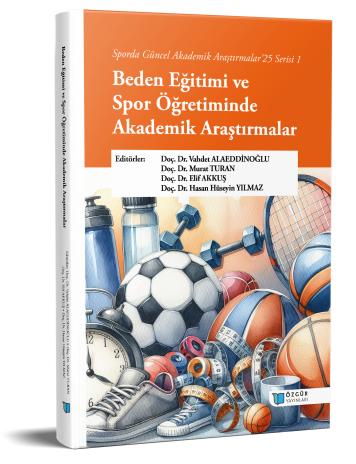
Psychology of Physical Education
Chapter from the book:
Alaeddinoğlu,
V.
&
Turan,
M.
&
Akkuş,
E.
&
Yılmaz,
H.
H.
(eds.)
2025.
Academic Research in Physical Education and Sports Teaching.
Synopsis
This study examines the multidimensional relationship between sport and educational psychology by exploring the cognitive, emotional, social, and performance-related effects of sport participation. Beyond physical skill development, sport functions as a powerful educational tool that enhances motivation, anxiety regulation, self-efficacy, psychological resilience, self-perception, and social adjustment. The literature demonstrates that regular sport participation reduces anxiety, strengthens self-confidence and academic motivation, and that digital sport education programs improve learning, attention, and performance feedback processes. Core concepts of sport psychology—including motivation, stress and anxiety management, imagery, and emotional regulation—emerge as critical determinants of performance in both individual and team sports. Mental training techniques have been shown to improve athletes’ focus, confidence, and cognitive flexibility, thereby enhancing overall performance. Sport injuries not only produce physical consequences but also increase anxiety, fear of re-injury, and motivational decline; psychological support during rehabilitation strengthens athletes’ engagement and recovery outcomes. In childhood and adolescence, sport contributes to identity development, social adaptation, and emotional regulation, serving as a protective factor against psychosocial risks. Sport psychologists play a crucial role in performance enhancement, team dynamics, injury rehabilitation, and mental health support. Furthermore, sport psychology research relies heavily on both qualitative and quantitative methods, including scale development, adaptation studies, factor analyses, and psychometric evaluations, underscoring the methodological diversity within the field. Overall, this study offers a comprehensive interdisciplinary evaluation of the educational and psychological functions of sport and highlights sport psychology’s expanding scope in both research and applied practice.
How to cite this book
License

This work is licensed under a Creative Commons Attribution-NonCommercial 4.0 International License.
Published
DOI
Categories
Copyright (c) 2025 Vahdet Alaeddinoğlu- Murat Turan- Elif Akkuş- Hasan Hüseyin Yılmaz; Mehmet Karasu- Yaşar İsmail Gülünay- Abdullah Yıkılgan- Hüseyin Dönmez- Burak Tozoğlu- Erdoğan Tozoğlu- Arzu Gülbahçe- Yavuz Akkuş- Murat Özkan- Haluk Aslantürk- Menduha Satır Kayserili- Muhammet Emin Kayserili