
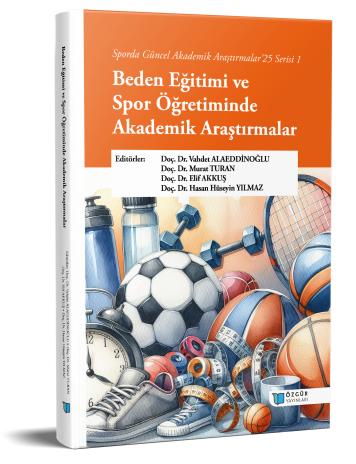
The Power of Art in Athlete Training: Developing Visual Communication and Visual Perception Skills
Chapter from the book:
Alaeddinoğlu,
V.
&
Turan,
M.
&
Akkuş,
E.
&
Yılmaz,
H.
H.
(eds.)
2025.
Academic Research in Physical Education and Sports Teaching.
Synopsis
Visual perception and visual communication skills are fundamental cognitive components that enable athletes to interpret environmental stimuli quickly and accurately, effectively manage motor decision-making processes, and optimize their performance. Developing these skills in individuals involved in sports and sports education requires more than just physical training; it necessitates a multidisciplinary and interdisciplinary educational approach. In this context, art education practices stand out as an effective educational field that supports individuals' higher-level perceptual processes such as visual awareness, aesthetic sensitivity, attention, focus, and visual memory. This section addresses the contributions of art education to the development of visual communication language and visual perception skills in athletes and individuals involved in sports education, both theoretically and practically. The positive reflections of visual arts-based activities on athletic performance and communication processes by increasing athletes' game reading, movement analysis, and body language awareness are discussed. In conclusion, it is emphasized that integrating art education practices into sports education programs is an important and necessary educational strategy that develops athletes' cognitive, perceptual, and communicative competencies through a holistic approach.
How to cite this book
License

This work is licensed under a Creative Commons Attribution-NonCommercial 4.0 International License.
Published
DOI
Categories
Copyright (c) 2025 Vahdet Alaeddinoğlu- Murat Turan- Elif Akkuş- Hasan Hüseyin Yılmaz; Mehmet Karasu- Yaşar İsmail Gülünay- Abdullah Yıkılgan- Hüseyin Dönmez- Burak Tozoğlu- Erdoğan Tozoğlu- Arzu Gülbahçe- Yavuz Akkuş- Murat Özkan- Haluk Aslantürk- Menduha Satır Kayserili- Muhammet Emin Kayserili