
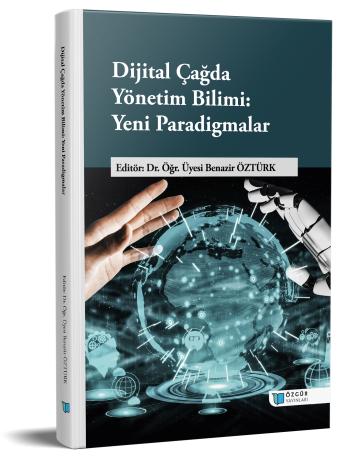
Digital Transformations in Management Science and Their Reflection in Turkish Public Administration
Chapter from the book:
Öztürk,
B.
(ed.)
2025.
Management Science in the Digital Age: New Paradigms.
Synopsis
In this study, the effects of digitalization on management science and its reflections on Turkish public administration are examined. Digital Technologies are fundamentally changing not only the nature of decision-making processes and leadership approaches, but also organizational culture and strategic management practices. The rapid development of digital technologies, the exponential growth of data, and the automation of business processes necessitate manager stoadopt more analytical, flexible, and agile approachestodecision-making. Digital transformation demonstrates that management science is not only under going a technocratic transformation but is also in the midst of an epistemological and the oretical restructuring process. In this sense, Technologies such as big data analytics, artificial intelligence, the Internet of Things, cloud computing, and robotic process automation have become components of modern management approaches. Digital technologies not only change the way management functions are performed but also necessitate a change in managers' competencies. There are also differences in how the digital transformation is reflected in countries. In this context, Türkiye is striving to provide citizens with faster, more efficient, digital, and accessible public services in a transparent and reliable manner by utilizing digital technologies in all areas of the public sector. Consequently, Türkiye is making continuous progress toward creating an information society by investing in digitalization. Inparticular, through e-government applications, Türkiye is increasing the effectiveness and efficiency of public administration by enabling citizens to conduct a large portion of their business digitally.
How to cite this book
License

This work is licensed under a Creative Commons Attribution-NonCommercial 4.0 International License.
Published
DOI
Categories
Copyright (c) 2025 Benazir Öztürk; Adil Karabal- Ahmet Kumru- Ülviye Kılıç Karakelle- Fatih Koç- Özlem Yaşar Uğurlu- Özge Sevimli- Mücahit Çakır- Ali Göde