
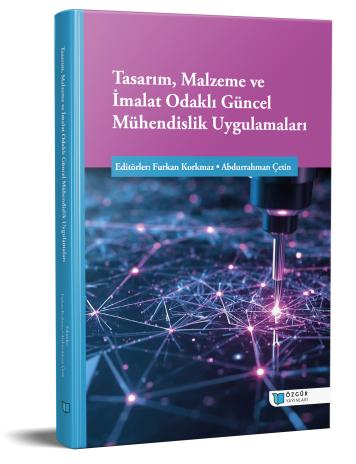
Finite Element Analysis of the Suitability of PLA Plus and PLA Wood Materials Produced with Different Nozzle Diameters in a 3D Printer for Chair Frames
Chapter from the book:
Korkmaz,
F.
&
Çetin,
A.
(eds.)
2025.
Current Engineering Applications Focused on Design, Materials, and Manufacturing.
Synopsis
In this study, the properties (hardness, tensile strength, and flexural strength) of PLA Wood and PLA Plus (PLA+, polylactic acid) parts produced with different nozzle diameters (0.2, 0.4, 0.6, 0.8, and 1.0 mm) using the fused deposition modeling (FDM) technique. Based on the findings, the mechanical properties of these materials to be used in the production of 3D-printed chairs were determined. Subsequently, a finite element analysis was performed on a chair design using the data of the 3D-printed materials. Within the scope of the study, various recommendations were made regarding the effect of nozzle diameters on the properties of parts produced by 3D printing and their suitability for use as chair materials. The results showed that the sample colors did not change according to the nozzle diameters, but the PLA Plus material provided higher stiffness, tensile strength, and flexural strength compared to PLA Wood. The surface roughness of the PLA Wood parts was found to be higher than that of the PLA Plus samples. Finite element analyses showed that equivalent stress values did not differ significantly depending on the material type (PLA Plus / PLA Wood). While certain variations in deformation magnitude were observed in both materials depending on the nozzle diameter, the least amount of deformation occurred in the PLA Plus material printed with a 1 mm nozzle diameter.
How to cite this book
License

This work is licensed under a Creative Commons Attribution-NonCommercial 4.0 International License.
Published
DOI
Categories
Copyright (c) 2025 Furkan Korkmaz- Abdurrahman Çetin; Emel Çelik- Abdurrahman Çetin- Sinan Serdar Özkan- Nergizhan Anaç- Oğuz Koçar- Erhan Baysal- Furkan Parmaksız- Zeynep Hale Şimşir- Bilal Kaya- Furkan Korkmaz- Erhan İbrahimoğlu- Fatih Çalışkan- Tuğçe Tezel- Volkan Kovan