
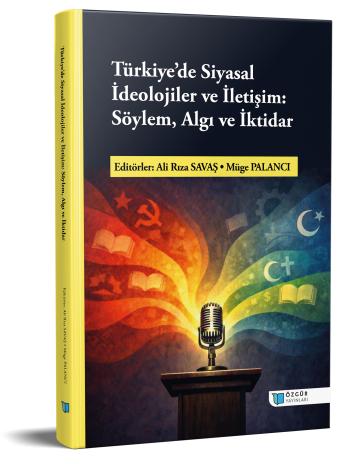
Turkey's Foreign Policy in The Grip of Global Politics and The Middle East: The Ak Party Era
Chapter from the book:
Savaş,
A.
R.
&
Palancı,
M.
(eds.)
2025.
Political Ideologies and Communication in Turkey: Discourse, Perception, and Power.
Synopsis
It is known that Turkey's long-standing pro-Western and status quo foreign policy focused more on the impact of relations with the West than on national interests. The changes in global politics after the Cold War initiated a new era in Turkey's foreign policy. Entering the new century with this foreign policy vision, Turkey has increasingly faced regional and global powers in international relations. Globalization, along with the Gulf War and developments in the Middle East after 9/11, have been significant factors in shaping the new concept of Turkish foreign policy. This situation also demonstrated the need for new approaches in foreign policy.
In the 2000s, Turkey revised its foreign policy and began to pursue an active foreign policy in response to developments in the region and the world. It is noteworthy that during this period, where the economy also played a significant role, foreign policy had to be conducted in a multifaceted, multidimensional way, involving many different actors. For over twenty-three years, the AK Party governments, which have shaped foreign policy, have followed a different path from the traditional understanding through discourses such as "central country," "zero problems with neighbors," "soft power," "humanitarian foreign policy," and "rhythmic diplomacy." However, domestic political problems and regional developments have been considered barriers to Turkish foreign policy. Despite this, Turkish foreign policy actors have sought ways to pursue an independent foreign policy across a wide spectrum, from the Middle East and Central Asia to Africa and South America. Compared to previous periods, the new era of foreign policy is notably described as a complex equation with many unknowns. This is because international relations, foreign policy, and diplomacy have become arenas of fierce competition. Despite all this, the possibility of conducting a value-centered, humanitarian foreign policy in accordance with moral norms is emphasized.
In addition to the factors affecting foreign policy, the study also discusses the changes that Turkish foreign policy has experienced in recent years. In this context, a comprehensive literature review has been conducted on Turkey's foreign policy actions. This study differs from similar works because it includes diverse assessments and specifically touches upon clues regarding the fundamental parameters of Turkish foreign policy during the AK Party era.
How to cite this book
License

This work is licensed under a Creative Commons Attribution-NonCommercial 4.0 International License.
Published
DOI
Categories
Copyright (c) 2025 Ali Rıza Savaş- Müge Palancı; Ali Rıza Savaş- Cengiz Gürbüz- Ertuğrul Buğra Orhan- Şaban Öztürk- Ahmet Hikmet Zabun- Ayşegül Melis Yurdakul- Müge Palancı