
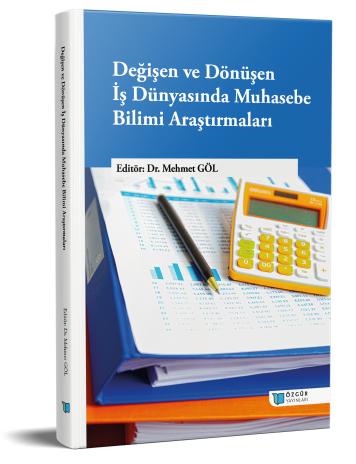
Adaptation of Accounting and Finance Functions of Recreation Enterprises in a Digitalizing World
Chapter from the book:
Göl,
M.
(ed.)
2025.
Accounting Science Research in a Changing and Transforming Business World.
Synopsis
The rapidly changing economic, technological, and managerial dynamics of the 21st century have brought about a comprehensive transformation in the financial management processes of businesses. Digitalization reshapes financial decision-making structures by enhancing accuracy, speed, and efficiency in core financial functions such as accounting, budgeting, reporting, and financial analysis. Particularly, accounting, as a system for generating and recording information, has evolved into a more integrated, transparent, and analytical structure with the influence of digital technologies (Göl, 2023).
Recreation enterprises, with their service-intensive and customer-oriented nature, significantly benefit from the use of digital financial tools. These tools support managers’ decision-making processes in critical areas such as income–expense management, cost analysis, dynamic pricing, efficient resource allocation, and performance measurement.
The aim of this study is to examine the impact of digitalization on the financial and accounting functions of recreation enterprises and to evaluate how this transformation reflects on business performance. A literature review method was employed; current research related to digital transformation, financial management, and the recreation sector was analyzed. Findings reveal that digital technologies reduce the margin of error in financial data processing, facilitate cost control, and save time for managers at strategic decision points.
In conclusion, it is demonstrated that digitalization strengthens financial sustainability in recreation enterprises, creates competitive advantage, and transforms the accounting function into a strategic information system.
How to cite this book
License

This work is licensed under a Creative Commons Attribution-NonCommercial 4.0 International License.
Published
DOI
Categories
Copyright (c) 2025 Mehmet Göl; Aysun Atagan Çetin- Murat Özdemir- Şifa Kirhasanoğlu- Mehmet Göl- Tevhit Kahraman- Adem Gömrükçü- Bekir Korkmaz- Mert Testere