
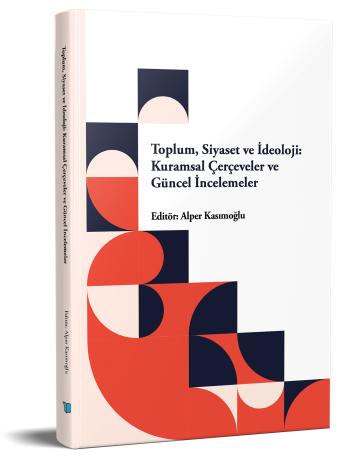
The Social Sources of Ideologies in the Context of Class, Identity, and Institutional Structures
Chapter from the book:
Kasımoğlu,
A.
(ed.)
2025.
Society, Politics and Ideology: Theoretical Frameworks and Contemporary Analyses.
Synopsis
This article examines the social origins of political ideologies through the interplay of class positions, collective identities, and institutional arrangements. Drawing on a literature-based conceptual synthesis, it offers a comparative discussion of the historical conditions under which liberalism, socialism, and nationalism emerged. Along the class axis, it considers how ideological repertoires legitimate, mediate, or transform conflicts of economic interest. Along the identity axis, it analyses the construction of “us/other” boundaries and the role of politics of belonging in political mobilisation. Along the institutional axis, it explores the mechanisms through which fields such as the state, law, education, and the media produce ideology, circulate it, and transmit it across generations. The article treats ideologies not only as normative doctrines but also as practical frameworks that make social experience intelligible and coordinate collective action; it therefore discusses processes of legitimacy production together with dynamics of opposition and reconfiguration, while also engaging—where relevant—with contemporary debates on identity politics. Although the study does not provide an empirical test, it aims to supply a conceptual foundation for case studies that trace class–identity–institution interactions. Brief references to Turkey illustrate how the relative weight of these three axes may shift across periods and help to outline an analytical agenda for comparative research.
How to cite this book
License

This work is licensed under a Creative Commons Attribution-NonCommercial 4.0 International License.
Published
DOI
Categories
Copyright (c) 2025 Alper Kasımoğlu; Ali Kiriktaş- Gamze Erdoğan- İlyas Erdoğan- Erhan Örselli- Zekeriya Bilici- Emre Feyzi Çolakoğlu- Sinem Yüksel Çendek- Alper Kasımoğlu