
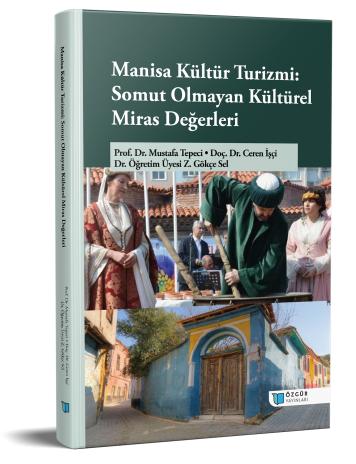
MANISA CULTURAL TOURISM: Intangible Cultural Heritage Values
Synopsis
The homogenizing effect of globalization on local identities has positioned the preservation and continuity of cultural heritage at the center of contemporary academic debates and public policies. In this regard, UNESCO’s "Convention for the Safeguarding of the Intangible Cultural Heritage" has conveyed the perception of cultural heritage beyond physical places and objects, focusing instead on the protection of living practices, representations, and knowledge. This book presents an academic perspective on the examination of Manisa’s Intangible Cultural Heritage assets, their cultural functions, and the integration of these values into the cultural tourism ecosystem.
Extending from antiquity to the Ottoman administrative period, Manisa embodies a deeply rooted historical continuity that authentically reflects Anatolia’s multi-layered cultural heritage. This heritage, blended with the city’s identity as the "City of Princes", has maintained its presence to the present day through daily life practices, traditional modes of production, and social rituals. However, the erosion of these assets in the face of modernization dynamics and technological developments has made it mandatory to document said heritage through scientific methods and to re-evaluate it from a tourism perspective.
Comprising eight main chapters, the first part of this study defines the concept of intangible cultural heritage and discusses the reciprocal interaction this heritage establishes with the tourism sector. By examining inventory studies across Turkey, particularly in Manisa, the role of Intangible Cultural Heritage elements in the socio-economic development process is established within a theoretical framework. The following chapters undertake an in-depth analysis of the city’s handicrafts, focusing on eight distinct practices—from talikacılık (traditional carriage making) and saddlery to felt-making and traditional door ornamentation—evaluated in terms of their production techniques, cultural significance, and prospects for sustainability..
In the subsequent sections of the book, weaving traditions and traditional clothing practices are addressed as indicators of the city’s ethnographic wealth. Social practices, belief systems, and major cultural events—particularly the Mesir Macunu Festival, which is included on UNESCO’s Representative List of the Intangible Cultural Heritage of Humanity—are assessed with respect to their significance in the city’s collective memory and their tourism potential. The sections on oral narratives, mythological layers, and culinary culture complete the holistic approach to Manisa’s living culture.
In the eighth chapter of the book, guided by the findings of the previous sections, strategic recommendations are provided for developing an intangible cultural heritage-based tourism approach in Manisa. This work is not limited to an inventory-building effort; it aims to be a scientific reference source that positions tourism as an effective tool for local development in the process of preserving and transmitting cultural heritage in Manisa from generation to generation.
We hope this work will serve as a theoretical and practical resource for researchers, industry professionals, and local policymakers working in the fields of cultural heritage management, tourism planning, and traditional handicrafts management. It is our greatest wish that this study, which brings together the cultural codes of the past with a vision for sustainable tourism of the future, contributes to the preservation of Manisa’s cultural identity.
How to cite this book
License

This work is licensed under a Creative Commons Attribution-NonCommercial 4.0 International License.
Published
ISBN
DOI
Statistics
Categories
Copyright (c) 2025 Mustafa Tepeci- Ceren İşçi- Z. Gökçe Sel