
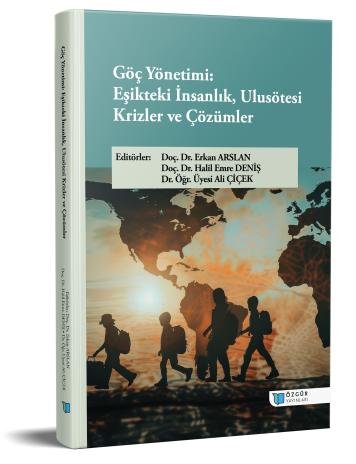
Migration and Nationalism in the AK Party Era
Chapter from the book:
Arslan,
E.
&
Deniş,
H.
E.
&
Çiçek,
A.
(eds.)
2025.
Migration Management: Humanity at the Threshold, Transnational Crises, and Solutions.
Synopsis
This chapter analyzes the multidimensional transformation of Turkey’s migration policies during the AK Party era, with particular emphasis on the various forms of nationalism that have shaped this process. Historically framed around nation-state building, security, and ethnic identity, Turkey’s migration policies were redefined under AK Party rule in line with international developments and the party’s ideological orientations. Based on a qualitative, literature-driven approach, the study aims to reveal the ideological foundations on which migration was positioned throughout the AK Party period.
The chapter examines the AK Party’s 23-year governance in three sub-periods. The first period, 2002-2011, represents a phase of institutionalization in migration management and alignment with liberal norms. Shaped largely by the EU accession process, this period moved Turkey away from an ethnically centered migration regime. Migration also became an instrument of foreign policy, as visa liberalizations and regional openings strengthened Turkey’s soft-power capacity. Nevertheless, the preservation of the geographical limitation indicates that nationalistic state reflexes did not fully disappear.
The 2011-2016 period marks an ideological break triggered by the mass influx resulting from the Syrian civil war. During this phase, the AK Party legitimized migration through the religious-historical “ansar-muhajir” discourse and blended conservative nationalism with a Neo-Ottoman perspective to shape its open-door policy. Consequently, migration management served both to reinforce Turkey’s international image and to consolidate the party’s conservative domestic base.
In the post-2016 period, rising economic costs, social tensions, and security concerns led to the growing dominance of territorial nationalism in migration policy. The discourse increasingly shifted toward security-oriented approaches: integration for those remaining and return policies for others. Yet the continued presence of integration measures shows that conservative inclusiveness did not entirely disappear.
Overall, the AK Party’s 23-year rule implemented a hybrid and fluctuating migration policy trajectory—transitioning from liberal openness to conservative, Neo-Ottomanist inclusiveness, and ultimately toward a more security-driven, territorial nationalist framework.
How to cite this book
License

This work is licensed under a Creative Commons Attribution-NonCommercial 4.0 International License.
Published
DOI
Categories
Copyright (c) 2025 Erkan Arslan- Halil Emre Deniş- Ali Çiçek; Erkan Arslan- Halil Emre Deniş- Fatih Demircioğlu- Ali Çiçek- Aslıhan Çiçek- Abdullah Turan- Abdulkadir Yüksel- Ömer Nabi Baykal- Didem Kayahan Yüksel - Pervin Bozkurt- Ömer Yılmaz- Fatime Gül Oktay Atsatan- Mustafa Uzan- Tolgay Ercan