
The Relationship Between Migration and Education: Theoretical Foundations, Processes, and Political Impacts
Chapter from the book:
Arslan,
E.
&
Deniş,
H.
E.
&
Çiçek,
A.
(eds.)
2025.
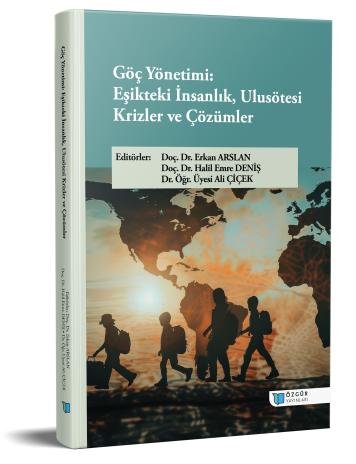
Migration Management: Humanity at the Threshold, Transnational Crises, and Solutions.
Synopsis
The purpose of this study is to examine the relationship between education and migration through a holistic approach grounded in theoretical foundations, processes, and policy impacts. In this context, migration is conceptualized not merely as a spatial movement but as a phenomenon encompassing profound transformations at cultural, social, and identity levels. Education, on the other hand, is regarded both as a cause of migration (such as brain drain and the pursuit of better opportunities) and as a consequence of migration. From this perspective, education plays a critical role in integration, social mobility, and psychosocial adaptation processes related to migration. Furthermore, the relationship between migration and education is analyzed within several theoretical frameworks, including Human Capital Theory, Bourdieu’s concepts of Cultural and Social Capital, Bronfenbrenner’s Ecological Systems Theory, the European Action Plan on Integration, and securitization and rights-based approaches. Within these frameworks, the study highlights the structural barriers and inequalities faced by migrant students in education, such as language barriers, cultural differences, and socio-economic disadvantages.
The findings indicate that the effects of migration on education can be examined across four main dimensions:
- Linguistic and academic adaptation challenges,
- Psychological trauma and social exclusion,
- Multiple dimensions of inequality in educational opportunities (socio-economic status, geographical disparities, school resources, gender, and disability),
- The role of institutional capacity in migration management.
Conversely, the effects of education on migration are evaluated in terms of:
- Strengthening social integration,
- Enhancing economic mobility and employment opportunities,
- Reducing societal prejudices.
At the policy level, strategic recommendations are emphasized, including multilingual education, teacher training and intercultural competence development, strengthening institutional infrastructure, and increasing family involvement. The study underscores that the education of migrant children constitutes not only a matter of individual academic success but also a strategic investment in social justice, democratic citizenship, and global solidarity.
How to cite this book
License

This work is licensed under a Creative Commons Attribution-NonCommercial 4.0 International License.
Published
DOI
Categories
Copyright (c) 2025 Erkan Arslan- Halil Emre Deniş- Ali Çiçek; Erkan Arslan- Halil Emre Deniş- Fatih Demircioğlu- Ali Çiçek- Aslıhan Çiçek- Abdullah Turan- Abdulkadir Yüksel- Ömer Nabi Baykal- Didem Kayahan Yüksel - Pervin Bozkurt- Ömer Yılmaz- Fatime Gül Oktay Atsatan- Mustafa Uzan- Tolgay Ercan