
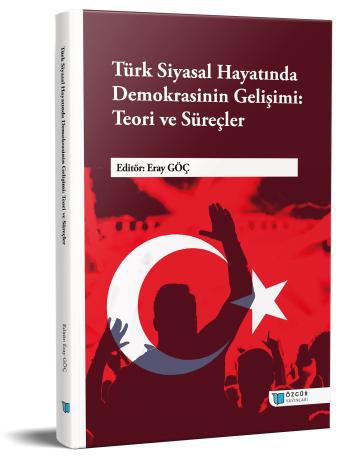
The Democratization Process of Turkish Law Enforcement Agencies After 2017 Within the Framework of European Union Official Documents
Chapter from the book:
Göç,
E.
(ed.)
2025.
The Development of Democracy in Turkish Political Life: Theory and Processes .
Synopsis
This article provides an in-depth examination of the democratization of Turkey's law enforcement sector post-2017, using official European Union (EU) documentation. This study utilizes a qualitative research approach to analyze the EU Progress Reports, Council papers, European Parliament resolutions, and Turkey's revised domestic security laws from 2017 to 2024 using content analysis. The analytical framework is organized around four principal topics prevalent in the democratic security literature: transparency, accountability, democratic oversight, and securitization.
The results demonstrate that Turkey has implemented a range of legislative and institutional changes to conform to EU norms, with notable advancements in in-service training for police officers, human rights-oriented methodologies, and professional ethical frameworks. The EU reports highlight that the enhanced concentration of executive authority subsequent to the 2017 constitutional amendment, the constriction of the separation of powers, and the centralization of decision-making have imposed new constraints on democratic supervision and oversight of law enforcement agencies. The findings emphasize that declines in judicial independence, legislative oversight, the efficacy of the ombudsman institution, and civil society engagement have adversely impacted the success of law enforcement reforms.
The research underscores the emergence of securitization discourse propelled by intensified national security apprehensions. This tendency has restricted the effective application of human rights norms and the democratic operation of law enforcement authorities. The expansive interpretation of counter-terrorism strategies, limitations on freedom of speech and assembly, and the augmentation of operational capabilities conferred to law enforcement are prominent concerns in EU evaluations.
In conclusion, the research recognizes that Turkey has implemented measures to democratize its law enforcement organizations; nonetheless, it reveals that EU reports express considerable apprehensions about the viability of these changes. The ongoing existence of structural issues, especially in execution and institutionalization, continues to hinder democratic initiatives. Thus, authentic compliance with EU norms necessitates the enhancement of independent oversight entities, the institutionalization of transparency measures, and the reconfiguration of the security-focused approach towards a more equitable governance model.
Keywords:
How to cite this book
License

This work is licensed under a Creative Commons Attribution-NonCommercial 4.0 International License.
Published
DOI
Categories
Copyright (c) 2025 Önder Aytaç Afşar; Eray Göç; Muhammet Ali Demir- Fecri Yıldırım- Selçuk Kahraman- Murat Ercan- Muhammet Yasin Elitok