
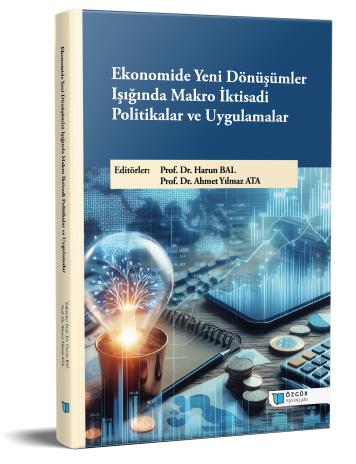
Gender-Based Unemployment in Türkiye: The Role of Inflation and Economic Growth
Chapter from the book:
Bal,
H.
&
Ata,
A.
Y.
(eds.)
2025.
Macroeconomic Policies and Practices in Light of New Transformations in the Economy.
Synopsis
The relationship between gender‑based disparities in the labor market and macroeconomic variables holds significant implications for policymakers. Investigating the dynamic nature of these relationships over time provides valuable insights that can enhance the effectiveness of policies aimed at combating unemployment. This study examines the impact of inflation and economic growth on male and female unemployment rates in Türkiye. The stationarity properties of annual time series covering the period 1991-2024 are analyzed using the Phillips‑Perron unit root test. The results indicate that economic growth is stationary at the level, whereas the other series become stationary after first differencing. Due to the mixed orders of integration, the ARDL bounds testing approach is employed to test for the existence of long‑run relationships among the series. The findings reveal that both male and female unemployment rates are affected by inflation and economic growth. Long‑run coefficients show that a one‑unit increase in inflation leads to a 0.021‑unit decrease in the male unemployment rate and a 0.027‑unit decrease in the female unemployment rate, while a one‑unit increase in economic growth leads to a 0.161‑unit decrease in the male unemployment rate and a 0.106‑unit decrease in the female unemployment rate. The error correction model indicates that short‑term disequilibria tend to adjust toward long‑term equilibrium. Diagnostic test results confirm the reliability of the models used. The results suggest that male employment tends to be concentrated in sectors that are relatively more responsive to economic growth, whereas female employment is concentrated in sectors that are relatively more sensitive to price movements. However, the limited differences in coefficients imply that the responses of male and female unemployment rates to macroeconomic variables are largely similar. This suggests that gender‑based unemployment differences in Türkiye cannot be fully explained by macroeconomic indicators alone. Therefore, achieving high and sustainable economic growth, increasing sectoral diversity, supporting flexible working arrangements, and expanding education and skills development programs can contribute to addressing this labor market issue.
How to cite this book
License

This work is licensed under a Creative Commons Attribution-NonCommercial 4.0 International License.
Published
DOI
Categories
Copyright (c) 2025 Harun Bal- Ahmet Yılmaz Ata; Doğan Barak- Halim Tatlı- Fatih Akın- Ayşe Eryer- Rüya Ataklı Yavuz- Refika Görkem Yılmaztürk- Selen Savaşkan- İlknur Aşkın- Harun Bal- Koray Yıldırım- Esma Erdoğan- Süleyman Gürbüz- Nur Aydın- Ayşe Arı- Mehmet Ozan Akman- Bahadır Aybakan- Devran Deniz- Mustafa Orhan Özer- Gökhan Özkul- Özgenur Çakır Uysal- Tahsin Avcı- Emre Kılıç- Eren Ergen