
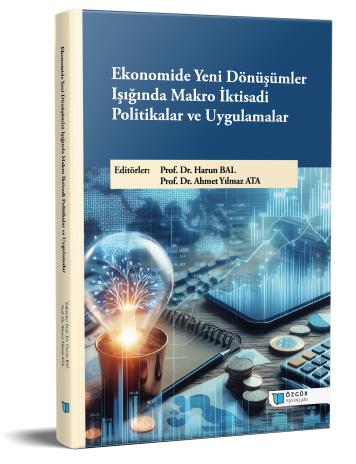
Changes in the Performance of Health Indicators in Türkiye Over Time: Evidence from the CRITIC-Based CoCoSo Method
Chapter from the book:
Bal,
H.
&
Ata,
A.
Y.
(eds.)
2025.
Macroeconomic Policies and Practices in Light of New Transformations in the Economy.
Synopsis
The aim of this study is to analyze the performance of health indicators in Türkiye over time within the framework of a multi-criteria decision-making (MCDM) approach. To this end, the changes in the performance of the health system across years are examined using data covering the 1999–2023 period. In the analysis, the CRITIC (Criteria Importance Through Intercriteria Correlation) method is employed to determine the weights of the criteria, while the CoCoSo (Combined Compromise Solution) method is used to rank health performance by year. The study considers a total of eleven health indicators, including total population, physicians, dentists, nurses, other health personnel, midwives, pharmacists, inpatient health institutions, the number of hospital beds by sector, total health expenditures, and the number of infant deaths. The findings obtained from the CRITIC method indicate that total health expenditures are the most important criterion in determining health performance, whereas the number of hospital beds by sector has the lowest relative weight. The performance rankings derived from the CoCoSo method reveal that the years with the highest health performance in Türkiye are 2021, 2020, and 2022, while the lowest-performing years are 1999, 2000, and 2002. The results suggest that the health system has experienced significant structural improvements in the post-2003 period and that the increase in health expenditures during the pandemic period has played a decisive role in shaping health performance indicators.
How to cite this book
License

This work is licensed under a Creative Commons Attribution-NonCommercial 4.0 International License.
Published
DOI
Categories
Copyright (c) 2025 Harun Bal- Ahmet Yılmaz Ata; Doğan Barak- Halim Tatlı- Fatih Akın- Ayşe Eryer- Rüya Ataklı Yavuz- Refika Görkem Yılmaztürk- Selen Savaşkan- İlknur Aşkın- Harun Bal- Koray Yıldırım- Esma Erdoğan- Süleyman Gürbüz- Nur Aydın- Ayşe Arı- Mehmet Ozan Akman- Bahadır Aybakan- Devran Deniz- Mustafa Orhan Özer- Gökhan Özkul- Özgenur Çakır Uysal- Tahsin Avcı- Emre Kılıç- Eren Ergen