
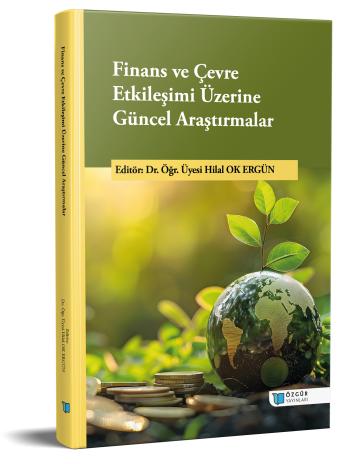
Sustainability Reporting: Conceptual Framework, Technical Structure, and Its Relationship with Firm Performance
Chapter from the book:
Ok Ergün,
H.
(ed.)
2025.
Current Research on the Interaction of Finance and the Environment.
Synopsis
This study presents a clear and comprehensive overview of sustainability reporting by examining its main concepts, technical development stages, content structure, and its connection to company performance.
The first part introduces the foundations of sustainability reporting, explaining how it emerged in response to the limitations of traditional financial reporting. It also shows how sustainability reporting aligns with global efforts such as the UN’s 2030 Agenda. This section outlines the evolution of major reporting standards like GRI, IFRS/ISSB (IFRS S1–S2), and ESRS, with an emphasis on the distinction between financial materiality and double materiality.
The second part focuses on how reports are prepared. It describes the methods used to gather and classify data, select ESG metrics, and engage stakeholders. It also explains how companies conduct materiality assessments. Key attention is paid to data quality, internal controls, and how sustainability reporting is integrated with corporate governance and risk management.
Next, the study explores the structure of sustainability reports, breaking down quantitative and qualitative disclosures. It examines ESG indicators, scoring systems, performance indices, and the use of strategic goals, KPIs, and KRIs to communicate progress.
Finally, the study reviews findings on the relationship between sustainability reporting and company performance. It concludes that sustainability reporting serves not just as a disclosure tool, but as a strategic component that can support financial and operational outcomes.
How to cite this book
License

This work is licensed under a Creative Commons Attribution-NonCommercial 4.0 International License.
Published
DOI
Categories
Copyright (c) 2025 Hilal Ok Ergün; Ayten Turan Kurtaran- Gökçe Ocak- İbrahim Karaaslan- Ayşegül Karadavut- Ferhat Demirci- Gülnaz Şengül Güneş- Sinan Güneş- İlker Sakınç- S. Öznur Sakınç- Yunus Bölükbaşı