
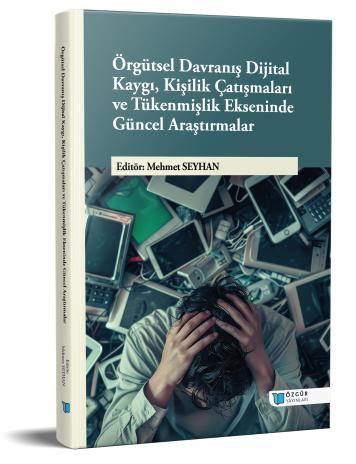
Basic Motivation Resources and Self-Perceived Leadership Behaviors: A Research on Individuals Playing Digital Games
Chapter from the book:
Seyhan,
M.
(ed.)
2025.
Organizational Behavior: Current Research on Digital Anxiety, Personality Conflicts, and Burnout.
Synopsis
The aim of this study is to examine the extent to which the basic motivation resources of university students playing digital games affect their self-perceived leadership behaviors. In the research conducted with 269 students from Süleyman Demirel University, a mixed-method approach was employed; quantitative data were collected via surveys, while qualitative data were obtained through open-ended questions. The findings indicate that the power and achievement motivation levels of digital gamers are significantly higher compared to non-gamers. Path analysis results revealed that affiliation motivation is the most significant predictor of participative and principled leadership perceptions. Furthermore, it was determined that power and achievement motivations positively influence self-confident leadership self-perception; affiliation motivation positively affects principled and participative leadership self-perceptions; and thinking motivation positively impacts decisive leadership perception. Additionally, the study observed that digital games are utilized as a domain for self-validation and progression by those with high achievement motivation; for dominance and control by those with high power motivation; for socialization and sharing by those with high affiliation motivation; and for mental focus by those with high thinking motivation.
How to cite this book
License

This work is licensed under a Creative Commons Attribution-NonCommercial 4.0 International License.
Published
DOI
Categories
Copyright (c) 2025 Mehmet Seyhan; Hazal Koray Alay- Merve Özer- Burak Özdemir- Ceyda Karakuş- Ezgi Nur Elalmış- Ramazan Furkan Özkul- Ahmet Sait Özkul- Yeşim Monus- Murat Nazlı- Oğuzhan Çamoğlu