
Experimental Economics: The Search for Causality in the Laboratory
Chapter from the book:
Polat,
M.
(ed.)
2025.
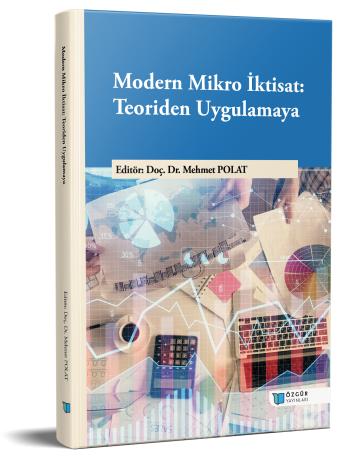
Modern Microeconomics: From Theory to Practice.
Synopsis
This study broadly examines the emergence of experimental economics, its historical development, its methodological basis, and its increasing value within the field of economics. The failure of traditional economics' abstract structure, based on assumptions of perfect rationality and equilibrium, to adequately explain people's real-life economic behavior has accelerated the use of experimental methods in economic analysis. Experimental economics enables the direct testing of economic theories by observing people's decision-making processes through controlled laboratory and field experiments. This approach aims to examine individuals' decision-making processes, strategic interactions, and market dynamics beyond the rational, self-interested actor model assumed by standard theories.
Thanks to pioneers such as Vernon Smith and Daniel Kahneman, experimental economics has ensured that theoretical arguments in economics can be tested for external validity. In particular, market experiments, public goods games, and laboratory versions of auction mechanisms have revealed how theoretical equations work in practice. Experimental findings have shown that the processes of reaching market equilibrium are significantly influenced by factors such as information asymmetry and behavioral biases. These studies, which reveal that real-world behavior does not fully conform to standard economic models, have accelerated the process of integration with behavioral economics. In recent years, increased technology use has also enabled large-scale online experiments, offering new opportunities for understanding the decision patterns of heterogeneous individuals. Experimental economics occupies a central position in both academic and applied research as an interdisciplinary approach that enriches theoretical frameworks and provides an empirical basis for policy design. In the future, experimental economics is expected to further deepen the study of heterogeneous behaviors through AI-supported experimental designs, big data analytics, and online platforms; and to offer more powerful inferential tools for policy evaluations by modeling spatial and dynamic decision-making processes. These developments will strengthen the interaction between theoretical and empirical economics.
How to cite this book
License

This work is licensed under a Creative Commons Attribution-NonCommercial 4.0 International License.
Published
DOI
Categories
Copyright (c) 2025 Mehmet Polat; Semra Koçak- Mehmet Polat- Cemal Öztürk- Muhammed Genç- Hatime Kamilçelebi- Dilek Alma Savaş- Muhammed İkbal Tepeler- Murat Özdemir- Özcan Özkan- Mustafa Özer- Demet Topal Koç