
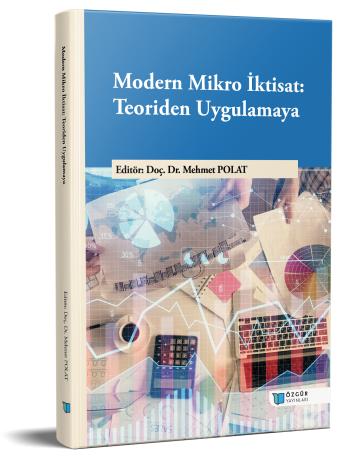
A Behavioral Microeconomic Perspective on Time Preferences, Borrowing, and Saving Decisions
Chapter from the book:
Polat,
M.
(ed.)
2025.
Modern Microeconomics: From Theory to Practice.
Synopsis
This book chapter examines individuals’ time preferences, borrowing, and saving decisions from a behavioural microeconomics perspective within a microeconomic framework. While traditional microeconomic theory assumes that individuals are rational, forward-looking, and time-consistent in their choices, a growing body of experimental and empirical evidence over the past five decades demonstrates systematic deviations from these assumptions. Behavioural models of time preference particularly hyperbolic and quasi-hyperbolic discounting show that individuals tend to overweight the present relative to the future, leading to time-inconsistent decisions. Such tendencies contribute to delayed saving, excessive borrowing, and increased financial vulnerability. The chapter analyses key behavioural mechanisms affecting financial decision-making, including present bias, mental accounting, self-control problems, and debt aversion. Using recent data from OECD countries and Türkiye, it provides a comparative assessment of household indebtedness, saving behaviour, and debt service burdens. The Turkish case offers a notable behavioural paradox: despite rapidly rising individual borrowing at the micro level, aggregate household debt remains relatively low by international standards, suggesting the importance of behavioural and institutional factors alongside macroeconomic conditions. Overall, the chapter aims to bridge behavioural economics and microeconomic theory by offering an integrated analysis of borrowing and saving behaviour and by providing policy-relevant insights grounded in both theory and empirical evidence.
How to cite this book
License

This work is licensed under a Creative Commons Attribution-NonCommercial 4.0 International License.
Published
DOI
Categories
Copyright (c) 2025 Mehmet Polat; Semra Koçak- Mehmet Polat- Cemal Öztürk- Muhammed Genç- Hatime Kamilçelebi- Dilek Alma Savaş- Muhammed İkbal Tepeler- Murat Özdemir- Özcan Özkan- Mustafa Özer- Demet Topal Koç