
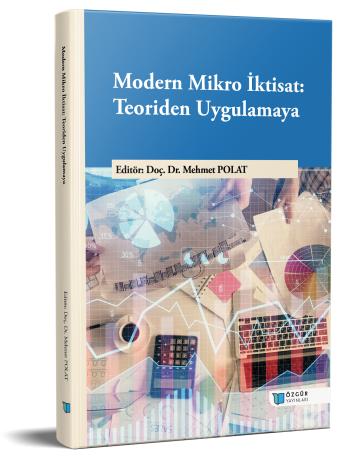
Forced Syrian Migration and Local Household Welfare: Evidence from Turkey
Chapter from the book:
Polat,
M.
(ed.)
2025.
Modern Microeconomics: From Theory to Practice.
Synopsis
This chapter examines the impact of forced migration of Syrian refugees on the well-being of the local population in Türkiye. Using micro-level data from the 2013 and 2018 Turkey Demographic and Health Surveys (TDHS), the study focuses on whether large-scale refugee influx affects the likelihood of local households belonging to higher welfare groups. Household well-being is measured using the TDHS well-being index, which categorizes households into five categories from poorest to richest. To address potential endogenousity arising from the non-random settlement of Syrian refugees in Turkish provinces and possible measurement errors in refugee statistics, an instrumental variable (IV) strategy is used in the analysis. Specifically, a distance-based instrument is constructed using weighted geographic distances between 14 Syrian governorates and Türkiye's 81 provinces, calculated via Google Maps. The empirical model is estimated using a two-stage least squares (2SLS) approach that controls for individual controls as well as year and province fixed effects. The results show that Syrian refugee influxes do not have a statistically significant effect on the likelihood of local women living in wealthier or wealthiest households. Robustness checks using alternative samples and subsample analyses confirm the main findings, although some differences were observed between urban and rural areas. Overall, the findings demonstrate that despite the documented impacts of refugee influxes on labor markets and prices, forced migration from Syria does not systematically alter the wealth distribution of local households in Türkiye. These results challenge widespread perceptions of widespread welfare losses and highlight the importance of evidence-based policy discussions on forced migration.
How to cite this book
License

This work is licensed under a Creative Commons Attribution-NonCommercial 4.0 International License.
Published
DOI
Categories
Copyright (c) 2025 Mehmet Polat; Semra Koçak- Mehmet Polat- Cemal Öztürk- Muhammed Genç- Hatime Kamilçelebi- Dilek Alma Savaş- Muhammed İkbal Tepeler- Murat Özdemir- Özcan Özkan- Mustafa Özer- Demet Topal Koç