
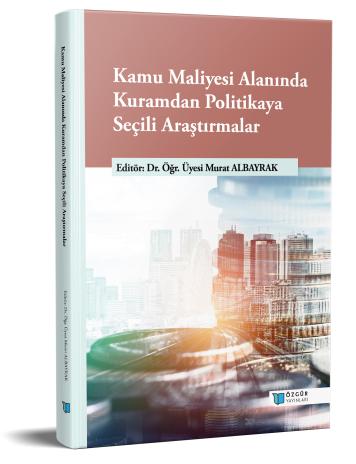
The Justification of Taxation: Overview of the Benefit and Ability-to-Pay Principles
Chapter from the book:
Albayrak,
M.
(ed.)
2025.
Selected Studies from Theory to Policy in Public Finance.
Synopsis
With taxes becoming a constant source of public financing, one of the issues that has been debated is the justification of taxes. At the center of these debates are the benefit principle and the ability-to-pay principle. Although the ability-to-pay principle is frequently emphasized in contemporary public economics theory, there is also extensive literature on the utility principle. Italian and Swedish economists have made a significant contribution to this literature. This study explains the advantages and limitations of the ability-to-pay that is the generally accepted principle in contemporary public finance and the benefit principle from a historical perspective. Although both principles have limitations in practice, because of difficulties in the benefit principle have not been overcome and, therefore this principle is not applied as a general taxation principle in this time. Both principles are examined from an objective perspective, without aiming to prove the superiority of one principle over the other in the study. The ability-to-pay principle has advantages in terms of applicability and ensuring horizontal and vertical equality, while the benefit principle has advantages in terms of efficiency and distributive-transactional justice. The debates surrounding on the ability-to-pay principle relate to the difficulties in determining that ability to pay. However, the benefit principle (especially in the case of pure public goods) has not resolved the problem of measuring benefit.
How to cite this book
License

This work is licensed under a Creative Commons Attribution-NonCommercial 4.0 International License.
Published
DOI
Categories
Copyright (c) 2025 Murat Albayrak; Cemil Altun- Osman Pehlivan- Abdülhamid Özgün Birkalan- Recep Tekeli- Muhammet Aktuğ- Hüseyin Ünal- Erkan Kılıçer- İmren Peker Kılıçer- Esra Hanbay Kahriman