
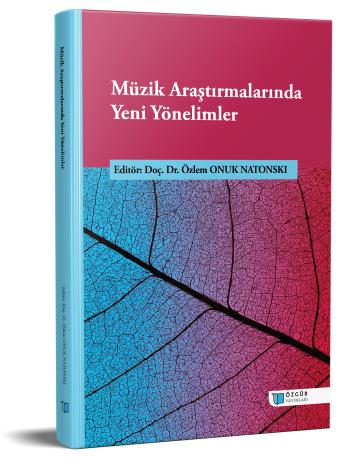
Reflections of Artificial Intelligence on Turkish Music
Chapter from the book:
Onuk Natonski,
Ö.
(ed.)
2025.
New Trends in Music Research.
Synopsis
This study comprehensively examines the positive and negative impacts of artificial intelligence technologies on Turkish music. With the acceleration of digitalization, artificial intelligence has become an important tool in the production, education, analysis, and archiving processes of Turkish music. Among the primary opportunities offered by technology are the mathematical modeling of maqam scales, the restoration of archival recordings, the support of compositional processes, and the proliferation of digital meşk applications. AI-powered analysis tools statistically analyze makam and tempo characteristics, while feedback systems used in education can evaluate student performance in terms of accuracy and appropriateness of makam. This expands the scope of music research and makes educational processes more accessible.
However, the impact of AI on Turkish music also brings with it certain risks. Chief among these risks are the superficialization of makam and stylistic depth, the decline of cultural diversity, ethical and copyright issues, and the marginalization of human expression. Learning from limited data by AI models can lead to a monotonous musical structure and weaken the stylistic knowledge that forms the foundation of the meşk tradition. Furthermore, incorrect or incomplete teaching of technology can lead to inaccurate learning of makams and usuls. Therefore, it is emphasized that AI should be positioned as a complementary tool supporting the tradition in Turkish music, not a substitute.
How to cite this book
License

This work is licensed under a Creative Commons Attribution-NonCommercial 4.0 International License.
Published
DOI
Categories
Copyright (c) 2025 Özlem Onuk Natonski; Fatih Tüysüz- Derya Kaçmaz- Duygu Ulusoy Yılmaz- Gamze Köprülü Yazıcı- Aziz Destegül- Hasan Mert