
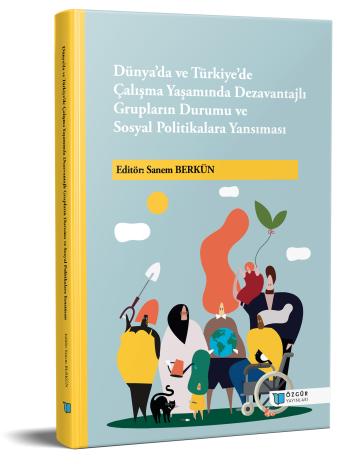
Analysis of Structural and Cultural Barriers Faced by Hearing-Impaired Individuals in Working Life
Chapter from the book:
Berkün,
S.
(ed.)
2025.
Disadvantaged Groups in Labor Life: Global and Turkish Perspectives on Social Policy.
Synopsis
The participation of hearing-impaired individuals in working life is one of the fundamental indicators of social justice and inclusive development. This study aims to analyze the problems encountered by hearing-impaired individuals in employment processes in Turkey within the axis of current legal legislation, social policies, and organizational practices. The theoretical framework of the study is built on the "Social Model," which seeks the problem in environmental and social barriers, rather than the "Medical Model," which views disability as an individual deficiency. Policy and thematic analyses conducted within the scope of the research reveal that although the quota system implemented in Turkey increases employment quantitatively, it brings along problems of "tokenism" and "idle labor" in qualitative terms. The main problem areas in working life are identified as communication barriers, lack of reasonable accommodation, social isolation, audist organizational culture, and the "glass ceiling" syndrome that hinders career progression. In conclusion, it has been determined that current social policies focus only on "placement" but remain insufficient in "retention" and "career development" processes. In this context, structural solutions such as expanding the job coaching system, making sign language training mandatory in workplaces, and conducting audits based on merit are proposed.
How to cite this book
License

This work is licensed under a Creative Commons Attribution-NonCommercial 4.0 International License.
Published
DOI
Categories
Copyright (c) 2025 Sanem Berkün- Burcu Karaca- Özlem Demir- Ali Kemal Terzi- Rabia Balcı- Olcay Besnili Memiş- Adnan Gülerman- Jale Taşoğlu- Beyza Uçar- Mukadder Bektaş