
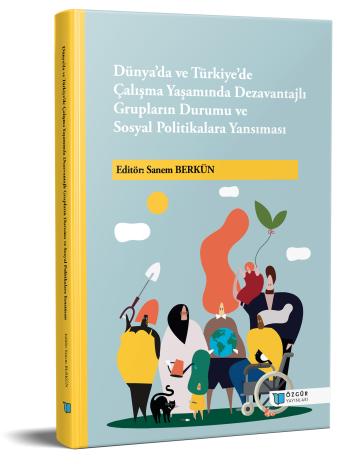
Just Transition in the Phase-Out of Fossil Fuels: Employment, Regional Vulnerabilities, and Social Policy
Chapter from the book:
Berkün,
S.
(ed.)
2025.
Disadvantaged Groups in Labor Life: Global and Turkish Perspectives on Social Policy.
Synopsis
This study scrutinizes the implications of the fossil fuel phase-out process on employment, regional development, and social policy within the framework of a Just Transition. The escalating global push towards low-carbon transformation, while imperative for mitigating greenhouse gas emissions, simultaneously engenders multi-dimensional socioeconomic risks for incumbent workers, fossil fuel-dependent regions, and vulnerable households. Consequently, a critical research inquiry centres on how job displacement in these sectors transcends mere employment figures, deepening into lifelong welfare degradation, erosion of social status, regional inequality, and energy poverty. Furthermore, a comparative analysis of case studies from Germany, Spain, the United States, and China is conducted to dissect the design, scope, and limitations of Just Transition policies across divergent institutional and political contexts. While long-term planning, negotiated transition agreements, and substantial regional funds in Germany and Spain yield comparatively inclusive outcomes, the absence of a binding national framework in the US and the institutional stratification based on ownership and employment status in China highlight the intrinsic fragilities of the Just Transition paradigm.
In conclusion, defining the normative underpinnings of Just Transition through energy justice, spatial justice, political economy, and labour-centric approaches demonstrates that policy designs failing to integrate distributive, procedural, and recognition justice are prone to generating novel inequalities. Accordingly, a comprehensive policy framework is proposed, comprising binding income and pension assurances, active labour market policies calibrated to local demand, dedicated regional transition funds, social policy instruments targeting energy poverty, and inclusive governance mechanisms. The central tenet of this work is that the fairness of the fossil fuel phase-out is not predetermined; rather, it is critically contingent upon deliberate social policy choices and institutional architecture.
How to cite this book
License

This work is licensed under a Creative Commons Attribution-NonCommercial 4.0 International License.
Published
DOI
Categories
Copyright (c) 2025 Sanem Berkün- Burcu Karaca- Özlem Demir- Ali Kemal Terzi- Rabia Balcı- Olcay Besnili Memiş- Adnan Gülerman- Jale Taşoğlu- Beyza Uçar- Mukadder Bektaş