
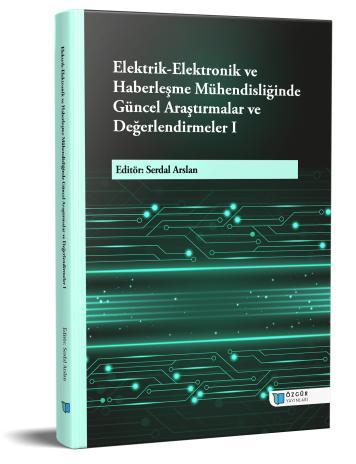
Current Research and Evaluations in Electrical-Electronics and Communication Engineering I
Synopsis
Electrical–Electronics and Communications Engineering and its sub-disciplines significantly influence almost every domain of modern life while simultaneously responding to evolving research demands. With this perspective, the book aims to contribute to the field by focusing on current applications and research areas within engineering disciplines. The book consists of seven (7) chapters, each offering original content on topics addressed within different sub-fields of Electrical–Electronics and Communications Engineering.
In the first chapter, the importance of filling materials used in high protection classes such as IP66 is addressed, and approaches for estimating the relative dielectric constant and loss factor of these materials are examined. In the second chapter, the concepts of the Internet of Things (IoT) and Artificial Intelligence of Things (AIoT) are discussed; moreover, the evolution of IoT into AIoT through integration with artificial intelligence, driven by rapidly increasing data generation and real-time decision-making requirements, is comprehensively evaluated.
In the third chapter, the technical specifications of different models belonging to the Deneyap Card family, which appeal to a wide range of users from beginner-level developers to advanced application developers, are examined, and their hardware differences are comparatively analyzed. In the fourth chapter, the fundamental approaches and concepts used in the management of time-series data generated by sensor-based systems are emphasized.
In the fifth chapter, in order to determine the most suitable synchronous generator type to be used in hydroelectric power plants, three alternative generator topologies are evaluated using a multi-criteria decision-making approach, and comparative analyses are carried out based on machine parameters. In the sixth, permanent magnet linear generators for wave energy applications are examined in detail; additionally, magnet selection for a flux-switching tubular linear generator is evaluated. The seventh and final chapter focuses on the NASA CMAPSS benchmark dataset and presents a comprehensive framework for fault prediction based on turbofan engine sensor data.
While hoping that this book, which we present as its first series, will contribute to the national and international literature in the field of Electrical-Electronics and Communications Engineering through the studies it contains, I would like to thank the authors who contributed to the book and Özgür Publications.
Chapters
How to cite this book
License

This work is licensed under a Creative Commons Attribution-NonCommercial 4.0 International License.
Published
ISBN
DOI
Statistics
Categories
Copyright (c) 2025 Serdal Arslan; Murat Demir- Ahmet Özmen- Süleyman Burçin Şüyun- Gülsüm Yıldırız- Emin Yıldırız- Serdal Arslan- Hasan Uzel