
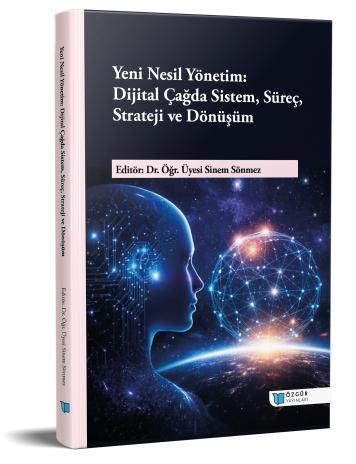
Corporate Mission, Vision and Values in the Digital Age
Chapter from the book:
Sönmez,
S.
(ed.)
2025.
New Generation Management: Systems, Processes, Strategy and Transformation in the Digital Age.
Synopsis
This book chapter examines mission, vision, and corporate values—the core elements of strategic management's corporate direction—in the context of the digital age. It discusses the decisive role of mission, vision, and values in corporate identity, strategic alignment, and decision-making processes within a holistic framework. The chapter attempts to explain, based on the literature, how mission, vision, and values serve as fundamental pillars that provide corporate-level answers to the questions “Why do we exist?”, “Where are we going?”, and “How will we behave?”. Furthermore, it emphasizes that these concepts are not merely symbolic meanings but references that organize the strategic planning cycle (analysis, direction, strategy development, implementation, monitoring, revision). In this context, it explains how mission, vision, and values are transformed into purpose, strategy, and implementation layers through the strategic direction pyramid approach.
The chapter also explains how digital transformation, artificial intelligence, and data-driven management have evolved corporate governance from static declarations to dynamic governance. Digital transformation requires redefining value and process design. Artificial intelligence and algorithmic decision systems, on the other hand, highlight ethical risks such as privacy, discrimination, bias, and lack of transparency, along with measurability. Therefore, it has become imperative for organizations to update their mission, vision, and values in line with human-centered artificial intelligence principles. Furthermore, it is recommended that values be redefined around accountability, fairness, data privacy, and digital ethics. Ultimately, this study seeks to explain that in the digital age, mission, vision, and values are more than just texts describing strategy; they are a mechanism that builds the system, aligns processes, and makes transformation sustainable.
How to cite this book
License

This work is licensed under a Creative Commons Attribution-NonCommercial 4.0 International License.
Published
DOI
Categories
Copyright (c) 2025 Sinem Sönmez; Ergül Söylemezoğlu- Neşe Kafa- Özden İbrahimağaoğlu- Miray Celepli Sütbaş- Gaye Atilla- Bülent Bayrak- Özge Öztürk- Çiğdem Pank Yıldırım- Duygu Akyüz- Şilan Özdamar- Ayhan Işık- Aytuğ Sözüer- Bünyamin Çelebi- Mehmet Aytekin- Lale Karasu- Emre Karasu- Mehmet Güven- Abdullah Fırat