
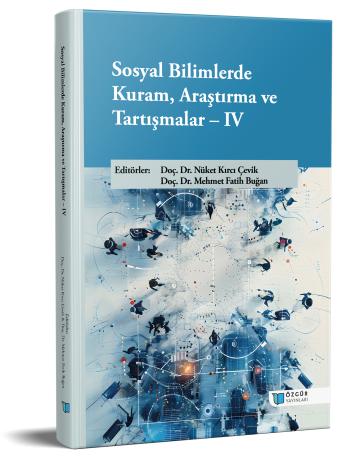
Circular Economy in the Context of Food Waste in Turkey: Opportunities for Youth Employment
Chapter from the book:
Kırcı Çevik,
N.
&
Buğan,
M.
F.
(eds.)
2025.
Theory, Research and Debates in Social Sciences - 4.
Synopsis
Food waste has emerged as a significant problem not only in terms of environmental degradation and environmental sustainability concerns, but also with regard to economic welfare. In this context, the circular economy, which appears as a sustainable policy approach, contributes to environmental sustainability through recycling and various practices, in addition to reducing waste. Moreover, circular economy practices create new job opportunities and thus offer the potential to address youth unemployment, which represents an important challenge for countries. In this study, the contributions of circular economy practices aimed at reducing food waste to youth employment in Türkiye are evaluated. The main findings indicate that circular economy practices targeting the prevention of food waste not only contribute to environmental sustainability, but also have the potential to generate new and qualified employment opportunities in areas such as recycling, biogas and fertilizer production, reverse logistics, and digital supply chains. These innovative fields of employment hold significant potential to support the labor market participation of the young workforce. Within this framework, supporting firms engaged in activities to reduce food waste and expanding practice-oriented training programs for young people may contribute not only to reducing youth unemployment, but also to achieving goals related to resource efficiency and environmental sustainability. The findings of the study are expected to provide a guiding framework for policymakers and for future research in this field.
How to cite this book
License

This work is licensed under a Creative Commons Attribution-NonCommercial 4.0 International License.
Published
DOI
Categories
Copyright (c) 2025 Nüket Kırcı Çevik- Mehmet Fatih Buğan; Saim Alper Ayas- Orhan Ecemiş- Orhan Orçun Bıtrak- Pınar Çelik Çaylak- Nisa Ekşili- Gamze Kara Çetinkaya- Gaye Gökalp Yılmaz- Melisa Başkuş- Ali Aslan Şendoğdu- Nezahat Koçyiğit- Şemseddin Gündüz- Esra Pekmez- Eral Ünsaç- Şükrü Mert Karcı- Ceyda Kükrer Mutlu