
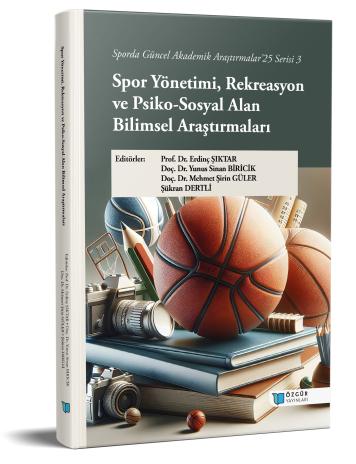
The Relationship Between Physical Activity and Cognitive Development in Children
Chapter from the book:
Şıktar,
E.
&
Biricik,
Y.
S.
&
Güler,
M.
Ş.
&
Dertli,
Ş.
(eds.)
2025.
Scientific Research in Sports Management, Recreation and Psycho-Social Field.
Synopsis
Physical activity is increasingly recognized as a fundamental developmental component that supports not only physical health but also cognitive development during childhood. Research in developmental psychology, neuroscience, and educational sciences consistently demonstrates that regular physical activity positively influences attention, working memory, executive functions, and academic performance in children. These effects are closely associated with the high level of neuroplasticity observed during childhood.
This book chapter aims to examine the relationship between physical activity and cognitive development in children from a theoretical, neurobiological, and applied perspective. First, the relationship between physical activity and cognitive processes is discussed within the frameworks of Piaget’s theory of cognitive development and Vygotsky’s sociocultural theory. These classical approaches are then integrated with contemporary neuroscientific findings, emphasizing mechanisms such as brain-derived neurotrophic factor (BDNF), synaptic plasticity, and prefrontal cortex activation. This integrative framework provides a comprehensive understanding of how physical activity regulates executive functions and attention processes.
The chapter also presents a synthesis of national and international research findings regarding the effects of physical activity on attention, inhibition, cognitive flexibility, and academic achievement. In addition, the contribution of physical play and movement-based learning activities to cognitive development is examined. Empirical evidence indicates that physical activity enhances cognitive functioning not only through short-term performance improvements but also by supporting long-term learning outcomes and academic success. Overall, the findings highlight physical activity as a powerful developmental and educational tool that should be systematically integrated into school programs and child-centered learning environments to support cognitive growth and academic achievement.
How to cite this book
License

This work is licensed under a Creative Commons Attribution-NonCommercial 4.0 International License.
Published
DOI
Categories
Copyright (c) 2025 Erdinç Şıktar- Yunus Sinan Biricik- Mehmet Şirin Güler- Şükran Dertli; Hatice Gezer- Gül Eda Burmaoğlu- Yunus Sinan Biricik- Emre Belli- Elif Ceylan- Muhammed Doğukan Tozoğlu- Eyüp Uğur- Sertaç Erciş- Arzu Gülbahçe- Sefer Karabağ- Ahmet Şirinkan- Vahdet Alaeddinoğlu- Yıldırım Gündoğdu- Ceren Solmaz Çakmak