
Therapeutic Recreation
Chapter from the book:
Şıktar,
E.
&
Biricik,
Y.
S.
&
Güler,
M.
Ş.
&
Dertli,
Ş.
(eds.)
2025.
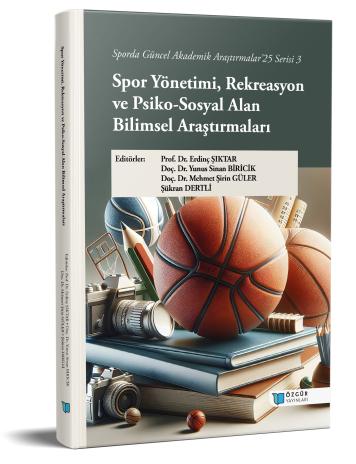
Scientific Research in Sports Management, Recreation and Psycho-Social Field.
Synopsis
In the modern era, the understanding of individual health and well-being is not limited merely to treating diseases or alleviating physical ailments, but requires a multidimensional approach aimed at improving the individual’s holistic quality of life. As the World Health Organization (WHO) emphasizes, health is not only the absence of disease or disability but a state of complete physical, mental, and social well-being. In this context, the concept of therapeutic recreation, which integrates leisure experiences with health and well-being, has become a popular area in contemporary literature.
Therapeutic recreation, in its most general sense, is a field of practice that enables individuals to utilize their leisure time not only for enjoyment but also for purposes of healing, rehabilitation, and social integration. The elements provided by recreation, such as enjoyment and social interaction, contribute directly to the physiological and psychosocial development of individuals when combined with a therapeutic approach. This approach is seen as a tool for improving the quality of life for diverse groups, ranging from the elderly to youth, and from those with chronic illnesses to individuals with special needs.
Historically, its roots trace back to the therapeutic use of dance and rituals in Ancient Egypt. In the modern sense, the discipline was solidified as a concrete therapy model through the work of pioneers like Philippe Pinel and William Tuke in the late 18th and early 19th centuries. Current studies indicate that therapeutic recreation provides significant benefits across physical health (e.g., muscle strength, mobility), cognitive functions (e.g., attention, problem-solving), and psychosocial dimensions (e.g., self-esteem, stress management). Specifically for individuals with disabilities, it functions as a fundamental component of rehabilitation, encouraging social integration and increasing the level of independent living. Consequently, therapeutic recreation is a scientific, central discipline that enhances life satisfaction and supports active participation in society.
How to cite this book
License

This work is licensed under a Creative Commons Attribution-NonCommercial 4.0 International License.
Published
DOI
Categories
Copyright (c) 2025 Erdinç Şıktar- Yunus Sinan Biricik- Mehmet Şirin Güler- Şükran Dertli; Hatice Gezer- Gül Eda Burmaoğlu- Yunus Sinan Biricik- Emre Belli- Elif Ceylan- Muhammed Doğukan Tozoğlu- Eyüp Uğur- Sertaç Erciş- Arzu Gülbahçe- Sefer Karabağ- Ahmet Şirinkan- Vahdet Alaeddinoğlu- Yıldırım Gündoğdu- Ceren Solmaz Çakmak