
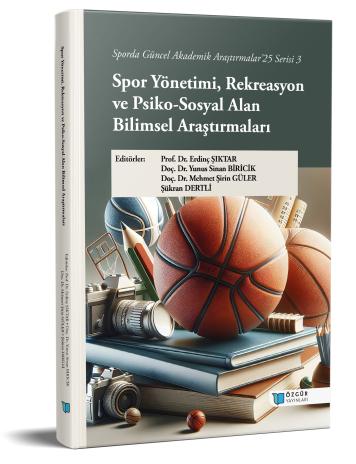
The Effect of Physical Education and Sports on Socialization Levels in Children With Autism
Chapter from the book:
Şıktar,
E.
&
Biricik,
Y.
S.
&
Güler,
M.
Ş.
&
Dertli,
Ş.
(eds.)
2025.
Scientific Research in Sports Management, Recreation and Psycho-Social Field.
Synopsis
Autism spectrum disorder is a difference resulting from a disorder caused by socio-communicative deficiencies due to the interaction of genetic and environmental factors. This difference affects many areas, from social life to work life. Therefore, research continues to minimize the difficulties faced by individuals with autism spectrum disorder (ASD) in many areas and to ensure they derive satisfaction from their lives. ASD symptoms appear most prominently in the early years of life and include limited interests, repetitive behaviors, weaknesses in social communication skills, speech difficulties, and poor motor skills. Motor skills affect both social adjustment and quality of life. Therefore, supporting the motor behavior of individuals with autism is of great importance. Endurance, strength, and speed constitute the basic motor characteristics. Flexibility and dexterity are complementary motor characteristics. Individuals need physical requirements to improve their movement quality and movement health. At this point, swimming takes its place among special sports by working many muscle groups and influencing the individual's development.
Swimming also contributes to processes such as individual development, maturation, and adaptation. Anthropometric measurements are assessments based on specific points that determine a person's weight, body measurements, strength, and range of motion.
How to cite this book
License

This work is licensed under a Creative Commons Attribution-NonCommercial 4.0 International License.
Published
DOI
Categories
Copyright (c) 2025 Erdinç Şıktar- Yunus Sinan Biricik- Mehmet Şirin Güler- Şükran Dertli; Hatice Gezer- Gül Eda Burmaoğlu- Yunus Sinan Biricik- Emre Belli- Elif Ceylan- Muhammed Doğukan Tozoğlu- Eyüp Uğur- Sertaç Erciş- Arzu Gülbahçe- Sefer Karabağ- Ahmet Şirinkan- Vahdet Alaeddinoğlu- Yıldırım Gündoğdu- Ceren Solmaz Çakmak