
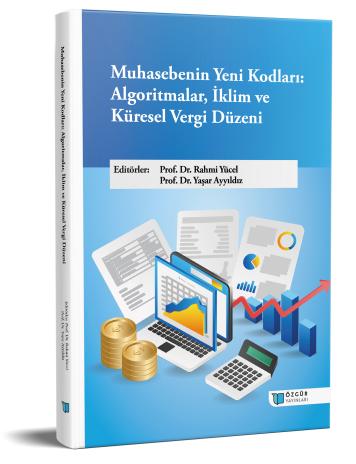
Digital Accounting and Technological Transformation
Chapter from the book:
Yücel,
R.
&
Ayyıldız,
Y.
(eds.)
2025.
The New Codes of Accounting: Algorithms, Climate, and the Global Tax System.
Synopsis
This chapter examines how digital transformation is reconfiguring the accounting function and accounting information systems through the lens of digital accounting. It first develops the theoretical foundation by integrating information systems perspectives with major technology adoption frameworks (TAM, TOE, TRI), and by discussing digital maturity and technology adaptation alongside international standard-setters’ orientations toward digitalization. The historical background is then outlined from Industry 1.0 to Industry 5.0, emphasizing the evolution of accounting practices. The chapter further analyzes the role and significance of accounting software by tracing the transition from basic bookkeeping tools to ERP and cloud-based systems, reviewing functional contributions and the broader software ecosystem. Data security and compliance are addressed through the perspectives of Turkey’s KVKK, the EU’s GDPR, and ISO/IEC 27001. In addition, emerging trends such as artificial intelligence, robotic process automation (RPA), and XBRL/iXBRL are discussed in terms of their implications for accounting and auditing processes. Blockchain is examined with respect to its core structure, potential contributions to accounting, practical use cases, and regulatory frameworks, including the EU Digital Finance Strategy and MiCA, as well as Turkey’s MASAK and SPK context; challenges and limitations are also highlighted. Finally, the chapter evaluates the impact of automation on processes, skills, digital ethics, and accounting education, concluding with an overall assessment of the transformation.
How to cite this book
License

This work is licensed under a Creative Commons Attribution-NonCommercial 4.0 International License.
Published
DOI
Categories
Copyright (c) 2025 Rahmi Yücel- Yaşar Ayyıldız; Rahmi Yücel- Fatih Eroğlu- Onur Özevin- Burcu Şimşek- Derya Yücel- Murat Özcan- Mehmet Günlük- Yaşar Ayyıldız- Emine Nur Yüksel- Serdar Şahin