
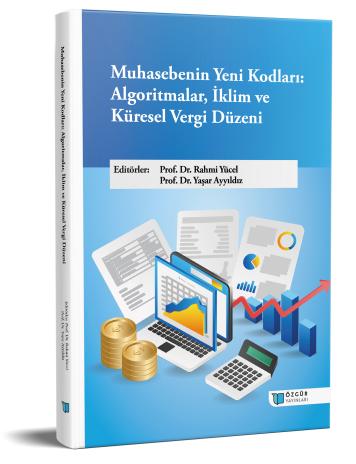
Accounting 4.0: Dijital Transformation, ESG, and the New Paradigm of the Profession
Chapter from the book:
Yücel,
R.
&
Ayyıldız,
Y.
(eds.)
2025.
The New Codes of Accounting: Algorithms, Climate, and the Global Tax System.
Synopsis
The accounting profession is undergoing a profound paradigm shift, commonly conceptualized as Accounting 4.0, which extends beyond its traditional historical role rooted in the legacy of Luca Pacioli. This study investigates the structural transformation of the profession through an integrated framework built on three interrelated pillars: (i) digital transformation driven by automation and artificial intelligence, (ii) sustainability and ESG alignment shaped by expanding social and regulatory accountability, and (iii) the emergence of a new professional paradigm accompanied by evolving competency requirements. Adopting a qualitative and integrative research design, the study methodology synthesizes recent academic literature, strategic reports of Big Four audit firms, professional guidance issued by global accounting bodies (e.g., ACCA), and the latest developments introduced by international standard setters, including the ISSB and the IFRS Foundation. This multi-source synthesis enables a comprehensive categorization of the technological and regulatory forces simultaneously redefining contemporary accounting practice. The findings reveal a fundamental shift in the role of accountants from transaction-oriented record keepers to strategic business partners and data-driven advisors. While Robotic Process Automation (RPA) increasingly assumes routine accounting functions and enhances operational efficiency, emerging regulatory frameworks require the systematic reporting of ESG-related information and the provision of reasonable assurance over its reliability. These developments necessitate the rise of an “Accountant 2.0” profile characterized by hybrid competencies encompassing digital literacy, ESG expertise, advanced analytical skills, and ethical judgment. The study concludes by emphasizing the need for curricular reform in accounting education, integrating data science, automation, artificial intelligence, and sustainability assurance, alongside the adoption of robust professional responses to growing cybersecurity and data privacy risks.
How to cite this book
License

This work is licensed under a Creative Commons Attribution-NonCommercial 4.0 International License.
Published
DOI
Categories
Copyright (c) 2025 Rahmi Yücel- Yaşar Ayyıldız; Rahmi Yücel- Fatih Eroğlu- Onur Özevin- Burcu Şimşek- Derya Yücel- Murat Özcan- Mehmet Günlük- Yaşar Ayyıldız- Emine Nur Yüksel- Serdar Şahin