
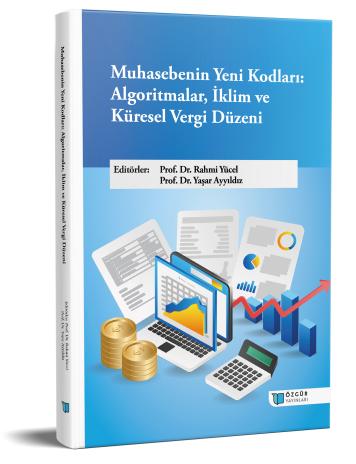
Corporate Sustainability Reporting: Reporting, CSR and Fundamental Standards
Chapter from the book:
Yücel,
R.
&
Ayyıldız,
Y.
(eds.)
2025.
The New Codes of Accounting: Algorithms, Climate, and the Global Tax System.
Synopsis
This study aims to examine sustainability reporting from a holistic perspective by addressing its conceptual, theoretical, and practical dimensions, and to analyze the interaction between corporate sustainability, corporate social responsibility (CSR), global reporting standards, and the accounting discipline. The increasing environmental, social, and governance (ESG) risks on a global scale have rendered the evaluation of corporate performance based solely on financial indicators insufficient, thereby positioning sustainability reporting as a fundamental component of corporate governance. In this context, the study highlights the transformation of sustainability reporting from a voluntary practice into a measurable, comparable, and auditable reporting system.
The study first discusses the concepts of sustainability and corporate sustainability and establishes a theoretical framework by relating these concepts to the corporate social responsibility approach. Subsequently, the development of sustainability reporting is examined within the framework of standardization, investor-oriented reporting, and integration processes, starting from early social and environmental disclosures. In this regard, the Global Reporting Initiative (GRI), the Sustainability Accounting Standards Board (SASB), the International Sustainability Standards Board (ISSB), and the Integrated Reporting Framework are comparatively evaluated in terms of their objectives, materiality approaches, and target stakeholder groups. Overall, the findings indicate that sustainability reporting should be regarded not merely as an ethical responsibility for organizations, but as a key governance mechanism that supports long-term value creation, risk management, and strategic decision-making processes.
How to cite this book
License

This work is licensed under a Creative Commons Attribution-NonCommercial 4.0 International License.
Published
DOI
Categories
Copyright (c) 2025 Rahmi Yücel- Yaşar Ayyıldız; Rahmi Yücel- Fatih Eroğlu- Onur Özevin- Burcu Şimşek- Derya Yücel- Murat Özcan- Mehmet Günlük- Yaşar Ayyıldız- Emine Nur Yüksel- Serdar Şahin