
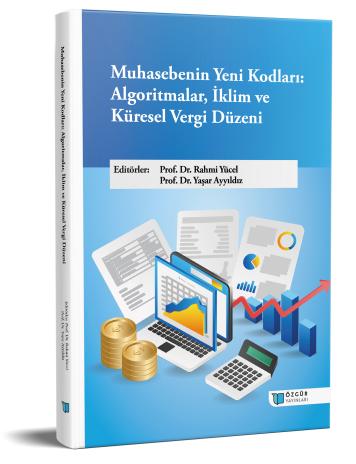
Green Taxonomy and Its Impact on Sustainability Reporting
Chapter from the book:
Yücel,
R.
&
Ayyıldız,
Y.
(eds.)
2025.
The New Codes of Accounting: Algorithms, Climate, and the Global Tax System.
Synopsis
This study comprehensively examines the concept of 'Green Taxonomy,' which has become the fundamental building block of the legal framework within the sustainability ecosystem, focusing on the European Union (EU) Taxonomy Regulation and the Draft Green Taxonomy Regulation of Türkiye. The research analyzes the transformative effects of classifying economic activities according to environmental sustainability criteria on businesses' financial reporting and green management processes. Research findings reveal that Türkiye's national taxonomy strategy is constructed on a balance between 'commercial integration' and 'national resilience.' Accordingly, while Türkiye ensures full alignment with the EU in the areas of 'climate change mitigation' and 'circular economy' to maintain competitiveness, it has adopted a unique approach in the headings of 'sustainable cities' and 'green infrastructure' in line with the country's geopolitical and climatic risks. The study also addresses how the taxonomy mechanism, working in integration with the Turkish Sustainability Reporting Standards and the GDS 3000 Assurance Audit Standard, minimizes the risk of 'greenwashing' through technical, legal, and auditing barriers. Furthermore, the study emphasizes the conclusion that the mandatory reporting process starting as of 2027 is more than just technical compliance for businesses; it is a vital 'strategic transformation' in terms of access to finance and corporate reputation.
How to cite this book
License

This work is licensed under a Creative Commons Attribution-NonCommercial 4.0 International License.
Published
DOI
Categories
Copyright (c) 2025 Rahmi Yücel- Yaşar Ayyıldız; Rahmi Yücel- Fatih Eroğlu- Onur Özevin- Burcu Şimşek- Derya Yücel- Murat Özcan- Mehmet Günlük- Yaşar Ayyıldız- Emine Nur Yüksel- Serdar Şahin