
Future Trends: The Accounting Profession in the Age of Artificial Intelligence
Chapter from the book:
Yücel,
R.
&
Ayyıldız,
Y.
(eds.)
2025.
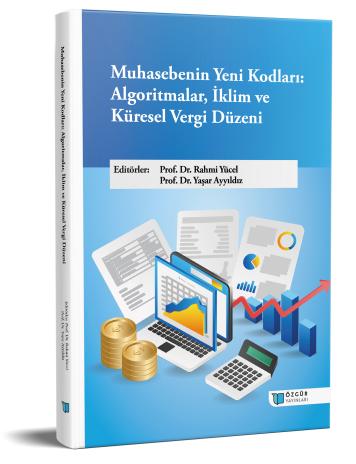
The New Codes of Accounting: Algorithms, Climate, and the Global Tax System.
Synopsis
This chapter examines the new phase of digital transformation in accounting and auditing in the context of the “AI era.” Building on the distinction between automation and transformation, it argues that transformation goes beyond faster processing and entails redesigning accounting information systems through end-to-end integration of processes/events, reconfiguring data flows, and reshaping audit and reporting functions. The chapter discusses four key technological components: cloud-based systems, ERP and SaaS ecosystems, big data, data analytics and advanced analytics, blockchain and distributed ledger approaches, and RPA and artificial intelligence applications. While AI and machine learning tools provide opportunities in document processing, classification, anomaly/fraud detection, continuous analysis and decision support, the chapter emphasizes emerging risks related to data privacy, cybersecurity, model bias, explainability, and accountability. Accordingly, it argues that AI should be framed not as “irresponsible automation” but as a governed system supported by transparency, traceability, and human oversight. It also highlights how developments in sustainability reporting and assurance (e.g., IFRS S1-S2) broaden the profession’s scope, increasing the relevance of “accounting engineering,” data governance, and analytical competencies. The chapter concludes with implications and recommendations for curriculum integration, continuous professional development, and regulatory frameworks.
How to cite this book
License

This work is licensed under a Creative Commons Attribution-NonCommercial 4.0 International License.
Published
DOI
Categories
Copyright (c) 2025 Rahmi Yücel- Yaşar Ayyıldız; Rahmi Yücel- Fatih Eroğlu- Onur Özevin- Burcu Şimşek- Derya Yücel- Murat Özcan- Mehmet Günlük- Yaşar Ayyıldız- Emine Nur Yüksel- Serdar Şahin