
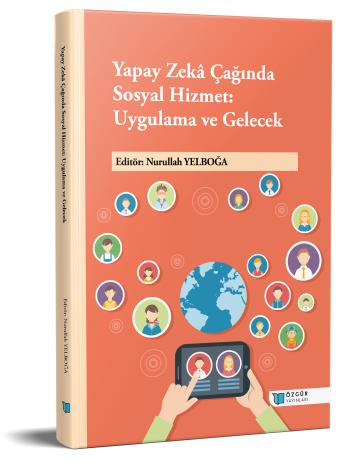
Artificial Intelligence and Digital Competencies in Social Work Education
Chapter from the book:
Yelboğa,
N.
(ed.)
2026.
Social Work in the Age of Artificial Intelligence: Practice and Future.
Synopsis
Moving from the historical breaking points where production relations and technological tools have reshaped human history, this study analyzes the new social phase developing on the axis of artificial intelligence (AI) and big data from the perspective of the social work discipline. Although social work is traditionally defined as a profession based on face-to-face interaction and empathy, today the digitalization process forces professional intervention forms and educational models into a radical transformation. The study argues that digital competence is no longer just a matter of technical "tool use" but an inseparable part of professional ethics and competence in order to defend the rights of clients and protect data privacy.
In the context of social work education, AI offers a "safe laboratory" area for students to improve interview techniques, perform risk analysis, and experience ethical decision-making processes through virtual reality simulations. However, the success of this technological integration depends on the systematic inclusion of digital competence and digital literacy concepts in the curricula. The study emphasizes the importance of raising social work students not only as individuals who can use existing technologies but also as proactive professionals who can struggle with digital exclusion and algorithmic biases. Consequently, the paradigm shift in social work education is a critical turning point for the future relevance of the profession, necessitating the strengthening of traditional pedagogical approaches with new-generation concepts such as "Information Ethics", "Algorithmic Advocacy", and "AI Literacy".
How to cite this book
License

This work is licensed under a Creative Commons Attribution-NonCommercial 4.0 International License.
Published
DOI
Categories
Copyright (c) 2026 Nurullah Yelboğa; Safter Bozarslan- Hatice Hale Yurttabir- Merve Karaman- Bekir Altıok- Kamil Ateş- İrfan Yıldırım- Muhammed Yusuf Bulut- Selman Bölükbaşı- Kadri Kınık