
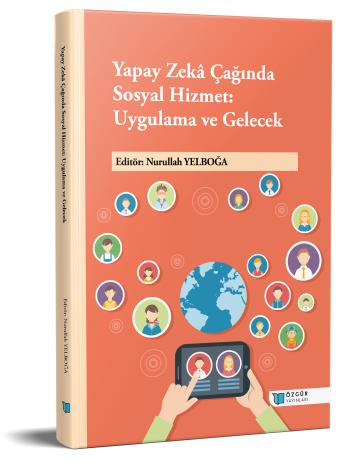
Transformation of the Family with Artificial Intelligence: Spirituality, Search for Meaning, and Digital Guidance
Chapter from the book:
Yelboğa,
N.
(ed.)
2026.
Social Work in the Age of Artificial Intelligence: Practice and Future.
Synopsis
Digitalization has entered a new phase with the development of artificial intelligence technologies. At this stage, human life is affected in many ways. In particular, the integration of artificial intelligence into daily life has led to the re-evaluation and redefinition of roles and responsibilities within the family. It has significantly affected individuals' daily and family life. Additionally, it has been observed that individuals use these platforms for spirituality, searching for meaning, and digital guidance. Ultimately, it is seen that individuals and families also receive consultancy services by utilizing artificial intelligence support. At the same time, consultants also benefit from this support. Especially consultants who provide individual counseling services to people can observe individuals' psychosocial conditions by using artificial intelligence and, as a result, offer personal advice regarding their biopsychosocial needs. Consultants who provide individual counseling services, in particular, are able to observe individuals' psychosocial conditions by using artificial intelligence and, as a result, offer personal advice regarding their biopsychosocial needs. Especially, when artificial intelligence tools provide feedback upon request, it increases the interaction between the family and artificial intelligence. This interaction and support, in turn, gives rise to digital family counseling services.
The digital family counseling service can increase its usage among families by providing financial and time savings to counselors, overcoming geographical boundaries, and offering easy accessibility. In this regard, the positive aspects of online family counseling, such as guiding the distribution of duties and roles within the family, reminding family members of their responsibilities, and enhancing unity and togetherness, stand out. However, concerns such as the ethical framework, data security, confidentiality, and privacy make this interaction process very critical. Especially with digitalization, which has become an inseparable part of our daily lives, the space for privacy has narrowed both temporally and spatially, and individuals' and families' concerns about privacy have increasingly grown, and these concerns have begun to transfer to digital spaces. From this point of view, the issue of digital privacy has become a fundamental agenda for the 'digital generation' that encounters technology from very early ages, as well as for their families. This study examines the impact of artificial intelligence, which has emerged with digitalization, on the family structure, analyzing its individual, familial, and societal consequences, and provides preventive, protective, and rehabilitative services in this direction.
How to cite this book
License

This work is licensed under a Creative Commons Attribution-NonCommercial 4.0 International License.
Published
DOI
Categories
Copyright (c) 2026 Nurullah Yelboğa; Safter Bozarslan- Hatice Hale Yurttabir- Merve Karaman- Bekir Altıok- Kamil Ateş- İrfan Yıldırım- Muhammed Yusuf Bulut- Selman Bölükbaşı- Kadri Kınık