
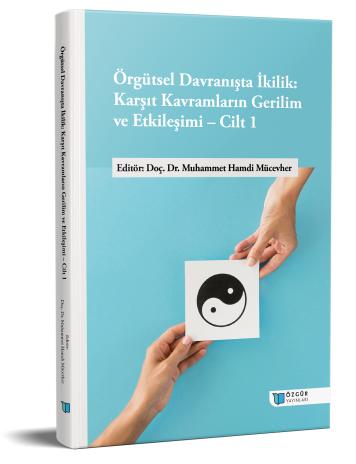
The Duality of Work Engagement and Burnout: Perspectives on Contrast and Interaction
Chapter from the book:
Mücevher,
M.
H.
(ed.)
2026.
Dualism in Organizational Behavior: The Tension and Interaction of Opposing Concepts – Volume 1.
Synopsis
This section examines the concepts of job commitment and burnout within a theoretical framework, explaining the relationship between the two concepts. Burnout is defined as a negative process resulting from prolonged work stress, leading to emotional exhaustion, depersonalization, and a decrease in the sense of personal accomplishment. In contrast, job commitment is a positive psychological state characterized by high energy, strong commitment, and focus on work. The literature acknowledges that these two concepts are closely related. The relationship between burnout and job commitment is explained by two main approaches. According to the first approach, burnout and job commitment are at opposite ends of the same continuum and reflect the positive or negative aspects of an individual's work experience. The second approach argues that, although related, these two concepts are distinct constructs and should be evaluated using separate measurement tools. It also emphasizes that organizational factors such as employee-job fit, workload, control, reward, belonging, fairness, and values are decisive in influencing both concepts. In conclusion, job commitment and burnout are two important and complementary concepts in understanding the psychological state of employees in their work lives. To improve working conditions, increase employee-job fit, and reduce burnout.
How to cite this book
License

This work is licensed under a Creative Commons Attribution-NonCommercial 4.0 International License.
Published
DOI
Categories
Copyright (c) 2026 Muhammet Hamdi Mücevher; Betül Okudur Sabuncu- Muhammet Hamdi Mücevher- Fatma Nur Karaca- Hatice Çoban Kumbalı- Gamze Solmaz- Hacer Orun Kavak- İfakat Atak- İbrahim Salih Çekim- Fatmanur Çeçen- Zeynep İlhan- Şengül Sağlam- Şerife Güzel- Hatice Sabırlı- Mehmet Ali Taş- Damla Aylin Erten- Esin Barutçu- Derya Dinçer Gültekin- Zeynep Duran