
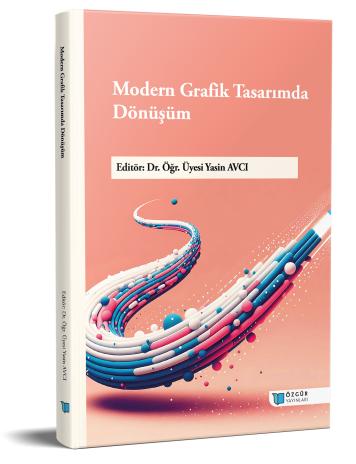
From History to Design: The Transformative Role of the Visual Culture of Turkish and Islamic Mythology in Modern Graphic Design
Chapter from the book:
Avcı,
Y.
(ed.)
2026.
The Transformation of Modern Graphic Design.
Synopsis
Although graphic design is considered a product of the modern era, its origins extend back to humanity's early practices of visual expression and meaning transmission. This path, which extends from cave paintings to mythological motifs, from lines to geometric motifs, should be approached not as decorative elements, but as visual codes that carry cultural memory, cosmological thought, and symbolic knowledge. In this context, the motifs and forms found in the Turkish and Islamic art tradition are not passive aesthetic elements; they are a readable and interpretable system of meaning. Fundamental design principles such as geometry, repetition, rhythm, and proportion are structured within the framework of the center-periphery relationship and the concept of infinity in Turkish and Islamic art. These principles are directly related to the modular structure, pattern design, and visual system approaches in contemporary graphic design. This study argues that motifs found in Turkish and Islamic mythology pioneered the formal and conceptual foundations of the contemporary graphic design discipline and should be evaluated not only as a formal reference but also as a design methodology and way of thinking.
How to cite this book
License

This work is licensed under a Creative Commons Attribution-NonCommercial 4.0 International License.
Published
DOI
Categories
Copyright (c) 2026 Kifayet Özkul; Yasin Avcı; Yasin Avcı- Mustafa Akman- Seyit Mehmet Buçukoğlu- Gökhan Koç- Leman Üstündağ