
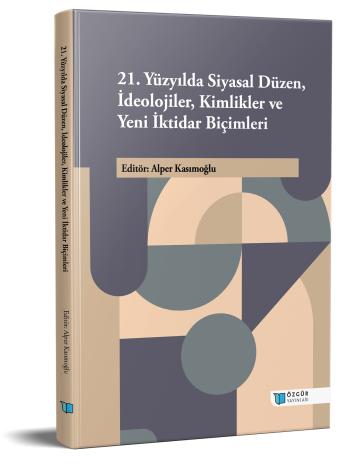
Political Order, Ideologies, Identities, and New Forms of Power in the 21st Century
Synopsis
This edited volume, titled Political Order, Ideologies, Identities, and New Forms of Power in the 21st Century, examines contemporary political transformations within a broad social and theoretical framework. The book aims to discuss, in an integrated manner, the restructuring of state–society relations, the contemporary functions of ideological orientations, the role of identities in the political sphere, and the changing manifestations of power. Globalisation, digitalisation, security-oriented modes of governance, economic vulnerabilities, migration, social inequalities, and regional conflicts are addressed as major dynamics shaping the contemporary political order. The volume explores how political orientations such as liberalism, conservatism, nationalism, social democracy, populism, and the new right have acquired new meanings in contemporary contexts, as well as their implications for citizenship, representation, legitimacy, public policy, and collective belonging. In addition, fields such as health systems, welfare regimes, and health governance are considered as concrete cases that make visible the relationship between ideology and institutional structures. The book also takes into account the significance of political and faith-based tensions, forms of violence, and their social, political, and international repercussions for understanding the present order. In this respect, the volume offers a comprehensive academic contribution to the analysis of the multilayered character of contemporary politics.
Chapters
How to cite this book
License

This work is licensed under a Creative Commons Attribution-NonCommercial 4.0 International License.
Published
ISBN
DOI
Statistics
Categories
Copyright (c) 2026 Alper Kasımoğlu; Ali Kiriktaş- Tuğba Kasımoğlu- Alper Kasımoğlu