
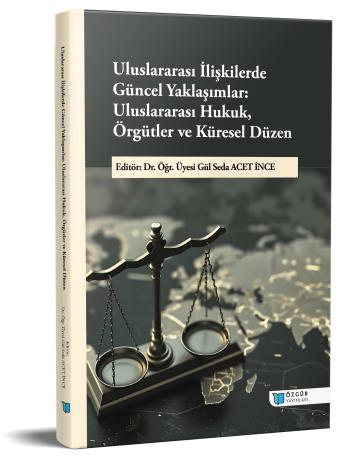
The 21st-Century Projection of the People’s Republic of China A Multipolar System or a Power Transition?
Chapter from the book:
Acet İnce,
G.
S.
(ed.)
2026.
Current Approaches in International Relations: International Law, Organizations, and the Global Order.
Synopsis
Power transition theory points to a shift in power among states within the global system. A change between the hegemonic power and a rising great power would lead to a comprehensive transformation of the global order. Developed by A. F. K. Organski, power transition theory focuses on the potential power transition between the United States of America and the People’s Republic of China in the contemporary global order. It is argued that the Belt and Road Initiative, launched by the People’s Republic of China particularly in recent years, constitutes a significant component of the power transition process between the United States of America and the People’s Republic of China. Accordingly, the People’s Republic of China has implemented the Belt and Road Initiative with the aim of replacing the United States of America, the hegemonic power within the global order. This study claims that the People’s Republic of China does not seek a multipolar system, but rather a power transition vis-à-vis the United States of America. Ultimately, it is clarified that the Belt and Road Initiative is not merely a development and geopolitical project.
How to cite this book
License

This work is licensed under a Creative Commons Attribution-NonCommercial 4.0 International License.
Published
DOI
Categories
Copyright (c) 2026 Gül Seda Acet İnce; Ahmet Üçağaç- Figen Aydın- Ayşe Gökçe Arslan- Burcu Gökatalay- Meliha Elif Güven- Hande Sapmaz- Zuhal Çalık Topuz- Canan Kışlalıoğlu- Sıddık Arslan- Burak Kurtcebe