
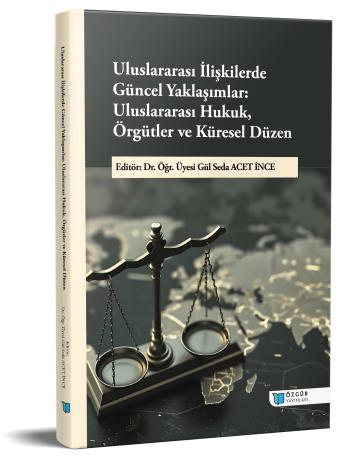
International Business Strategies within the Framework of International Law
Chapter from the book:
Acet İnce,
G.
S.
(ed.)
2026.
Current Approaches in International Relations: International Law, Organizations, and the Global Order.
Synopsis
This chapter challenges the prevalent treatment of law in international business (IB) as a background “country-level institutional quality” proxy and instead conceptualizes international law as a stratifying institutional architecture that structures firm strategy through identifiable causal mechanisms. Drawing on institutional theory and the institution-based view, it reinterprets the hard law–soft law distinction—hard law encompassing WTO disciplines, BITs, ISDS arrangements, and sanctions/embargo regimes; soft law including the UN Guiding Principles on Business and Human Rights and the OECD Guidelines—as a multi-level governance field that redefines multinational enterprises’ (MNEs) feasible strategy set. Within this framing, law is not merely an exogenous source of regulatory risk; it also operates as an enabling infrastructure that can generate predictability, rights-based protection, and legitimacy standardization, thereby creating strategic opportunities and competitive advantages. The chapter’s core analytical contribution is a mechanism-based account of how international trade law shapes foreign market entry. First, trade rules and agreements delineate market access conditions and constrain discriminatory practices, influencing entry feasibility and mode selection. Second, tariffs and technical regulations reshape production and global value chain configurations via compliance costs, product standardization imperatives, and geographic reallocation of activities. Third, trade policy uncertainty affects the timing of entry and investment by altering the option value of waiting under irreversible commitments, thereby delaying or reconfiguring internationalization trajectories. In parallel, sanctions function as “institutional shocks” with a rule-rewriting effect, precipitating high-stakes decisions such as market exit, operational downscaling, and strategic repositioning. The chapter thus advances a conditional, dual-sided view of international law as both constraint-producing and advantage-enabling, contingent on firm-level capabilities (compliance capacity, legal literacy), sectoral exposure, and value-chain positioning. It concludes by outlining a research agenda oriented toward mechanism-based empirical tests and heterogeneity-sensitive designs that can more precisely estimate the strategic effects of legal regimes in contemporary geoeconomic turbulence.
How to cite this book
License

This work is licensed under a Creative Commons Attribution-NonCommercial 4.0 International License.
Published
DOI
Categories
Copyright (c) 2026 Gül Seda Acet İnce; Ahmet Üçağaç- Figen Aydın- Ayşe Gökçe Arslan- Burcu Gökatalay- Meliha Elif Güven- Hande Sapmaz- Zuhal Çalık Topuz- Canan Kışlalıoğlu- Sıddık Arslan- Burak Kurtcebe