
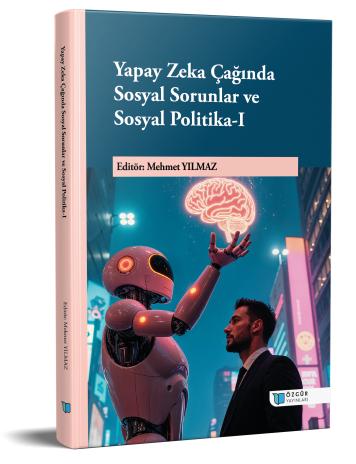
New Social Problems Arising from Digitalization and Artificial Intelligence Applications: A General Assessment
Chapter from the book:
Yılmaz,
M.
(ed.)
2026.
Social Problems and Social Policy in the Era of AI-I .
Synopsis
While digitalization and artificial intelligence (AI) technologies are fundamentally reshaping the functioning of modern society, they are also paving the way for a "new generation" of complex problems that go beyond traditional social issues. This study aims to provide a general evaluation of the transformations created by technological advancement in the social fabric through key axes such as social media manipulation, narcissism, digital isolation, and algorithmic discrimination.
Within the scope of the study, it is analyzed how the "persona" (mask) constructed by individuals to adapt to social expectations has become a necessity on digital platforms, and how this situation triggers cultural narcissism and self-alienation. In particular, the way social media algorithms imprison individuals in "echo chambers" by making them addicted to social validation is addressed as a primary source of social polarization and disinformation. Critical discussion points of the study include how AI applications create algorithmic exclusion against disadvantaged groups by inheriting biases from their training datasets, and the commodification of human behavior within the framework of surveillance capitalism, as conceptualized by Shoshana Zuboff.
Furthermore, the phenomena of digital isolation and loneliness, which develop independently of access to technology, are examined as social pathologies; the risk of "relational dehumanization" caused by AI companions replacing human bonds is highlighted. The fact that new-generation cyber threats, such as deepfakes and video injection attacks, undermine not only individual security but also the collective perception of truth reinforces the relevance of this study. In the conclusion, social policy recommendations such as "algorithmic transparency," "critical digital citizenship," and "human-centered technology regulations" are proposed to combat these emerging issues.
How to cite this book
License

This work is licensed under a Creative Commons Attribution-NonCommercial 4.0 International License.
Published
DOI
Categories
Copyright (c) 2026 Mehmet Yılmaz; Arif Akbaş- Cumhur Havan- Sergen Gürsoy- Nesrin Yazar- Mehmet Yılmaz