
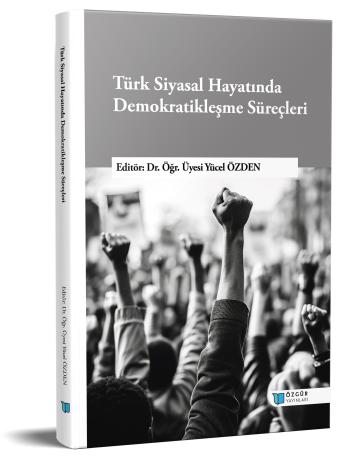
The Legitimation Discourse of Democratization during Turkey’s Transition to Multi-Party Politics (1945–1950)
Chapter from the book:
Özden,
Y.
(ed.)
2026.
Democratization Processes in Turkish Political Life.
Synopsis
This chapter examines Turkey’s transition to multi-party politics between 1945 and 1950 not as a linear and normative process of democratization, but as a hegemonic strategy developed in response to a legitimacy crisis. Drawing on a Gramscian theoretical framework, democratization is analysed beyond institutional reforms and electoral mechanisms, focusing instead on the re-organization of consent and the discursive reconstruction of the boundaries of the political sphere. The study argues that democratization was legitimized through key notions such as “democratic maturity”, “responsible opposition”, and “order and stability”, which simultaneously enabled political pluralism and constrained it within state-defined limits.
The discourse produced in Cumhuriyet newspaper reveals that democratization functioned not merely as an expansion of political rights but also as a mechanism for sustaining continuity in power relations. By conceptualizing the transition as a form of passive revolution, the chapter contributes to a critical understanding of the limits and enduring patterns of democratization in Turkish political life.
Keywords:
How to cite this book
License

This work is licensed under a Creative Commons Attribution-NonCommercial 4.0 International License.
Published
DOI
Categories
Copyright (c) 2026 Yücel Özden; Erdoğan Altun- Tülay Gül Polat- Umut Turgut Yıldırım- Mücahit İsmail Coşkun- Göktuğ Şeker