
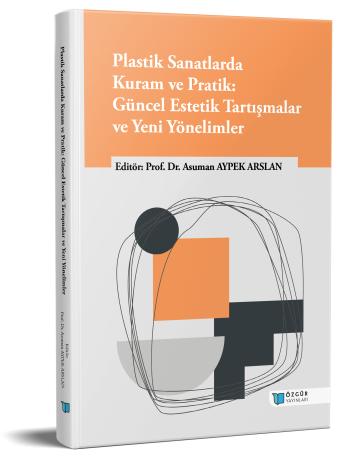
On the Threshold of Visibility: The Relationship Between Surface and Light in Fine Arts
Chapter from the book:
Aypek Arslan,
A.
(ed.)
2026.
Theory and Practice in the Visual Arts: Current Aesthetic Debates and New Trends.
Synopsis
In the field of fine arts, surface and light are not merely formal elements of artistic production; they are fundamental components that guide perception, transform visual experience, and play a decisive role in the formation of meaning. Surface, as the first point of contact between the artwork and the viewer, redefines the boundaries of visibility through its relationship with light. In this context, light emerges not as an element that fixes form, but as a dynamic, variable, and transformative field of influence moving across the surface. This study aims to address the relationship between surface and light in the context of fine arts as a plane of perception independent of representation. It discusses how the textural, matte-glossy, permeable, and deep properties of the surface in artistic production, interacting with light, generate different perceptual experiences. This interaction, instead of confining the meaning of the artwork to a singular and fixed reading area, offers a visual experience that changes depending on the viewer's position, perspective, and spatial conditions. The study evaluates this variable field created by the interaction of surface and light within the framework of the fundamental principles of fine arts; it proposes reading artistic production not only through the visible form but also through the perceptual layers formed at the threshold of visibility. This approach aims to draw attention to the transformative potential of the relationship between surface and light on artistic thought and visual experience.
How to cite this book
License

This work is licensed under a Creative Commons Attribution-NonCommercial 4.0 International License.
Published
DOI
Categories
Copyright (c) 2026 Asuman Aypek Arslan; Yasemin Tanrıverdi- Asuman Aypek Arslan- Mahmut Özkan- Mert Acar