
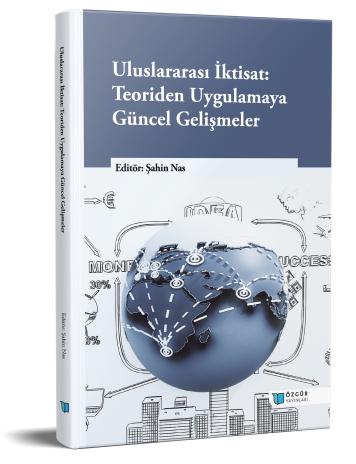
International Economics: Current Developments from Theory to Practice
Synopsis
With the acceleration of globalization in the world economy, international economics has become an increasingly important field of economic policy for countries. Under the impact of globalization, significant transformations have taken place in the economic policy framework that prevailed in the world economy, particularly during the 1945–1975 period. In this process, inward-oriented growth policies were largely abandoned and replaced by outward-oriented growth policies. With the transition to outward-oriented economic policies, foreign trade began to be regarded as one of the main instruments of development and economic growth. Accordingly, a significant increase was observed in world trade volume. The acceleration of globalization and the intensification of economic relations among countries have not only expanded the volume of foreign trade, but also fundamentally transformed the structure of production. As a result of this structural transformation in the world economy, production processes have acquired a global character. Today, production no longer takes place solely within a single country; rather, it is fragmented across different countries and regions, while countries seek to create added value by specializing in particular stages of the production process. In other words, countries are now focusing not only on the production of final goods and services, but also on specializing in specific stages of the production process of goods and services. This transformation in the global production structure has also increased the interdependence among economies. The emerging production structure has strengthened the need for both exports and imports. In particular, the use of imported intermediate inputs has become an important component of export-oriented production processes. This transformation in the global economy may generate different effects across countries. Indeed, global production and foreign trade have direct and indirect implications for many areas, including technological transformation, environmental pollution, production structure, productivity, economic growth, development, and income distribution. In this context, the main aim of this book is to examine the effects of recent developments in the field of international economics on economies from a multidimensional perspective. To this end, the book addresses such issues as international trade, digitalization, trade openness, environmental pollution, global value chains (GVCs), inequality, and high-technology exports, and analyzes the relationships among these issues within both theoretical and applied frameworks.
Chapters
How to cite this book
License

This work is licensed under a Creative Commons Attribution-NonCommercial 4.0 International License.
Published
ISBN
DOI
Statistics
Categories
Copyright (c) 2026 Şahin Nas; Ebru Arıcıoğlu- Pınar Tat- Nil Sirel Öztürk- Şahin Nas