
Thinking Beyond Sound: Intermedial Imagination in the Music of Franz Liszt
Chapter from the book:
Karamahmutoğlu,
G.
(ed.)
2026.
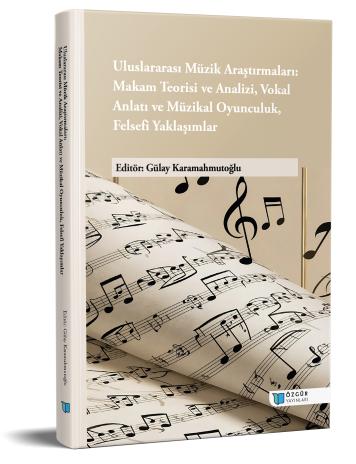
International Music Studies: Makam Theory and Analysis, Vocal Narrative and Musical Acting, Philosophical Approaches.
Synopsis
This chapter approaches Franz Liszt not merely as a piano virtuoso or the creator of the symphonic poem, but as a mediating figure who moved among literature, visual arts, religion, and philosophy within nineteenth-century European culture. Liszt’s compositional practice is not confined to the internal logic of sonic material alone. In his work, music extends “beyond itself” through titles, prefaces, epigraphs, images of stage and dance, pictorial iconography, and even publication strategies. Particularly following his settlement in Weimar, Liszt’s period of compilation and creation marks a critical threshold at which this interartistic imagination became an institutional mode of production, enabled by direct access to the orchestra, conducting activity, and practices of textual framing. The works discussed in this context are presented not as imitations of other arts, but as instances in which music establishes a new order of imagination within its own medium. Accordingly, the aim of this chapter is not to treat the Liszt repertoire merely as a domain of technical virtuosity, but to render visible the literary, visual, and theatrical modes of thought operating behind the written score. It also seeks to situate Liszt’s programmatic approach within music history and aesthetics, to question how listeners “read” a musical work, and to illuminate the aesthetic and social configurations that emerge at the intersection of music and other arts.
How to cite this book
License

This work is licensed under a Creative Commons Attribution-NonCommercial 4.0 International License.
Published
DOI
Categories
Copyright (c) 2026 Gülay Karamahmutoğlu; Altun Burcu Çankaya- M. Arda Balkay- Selen Balkan Erem- Güncel Gürsel Artıkay