
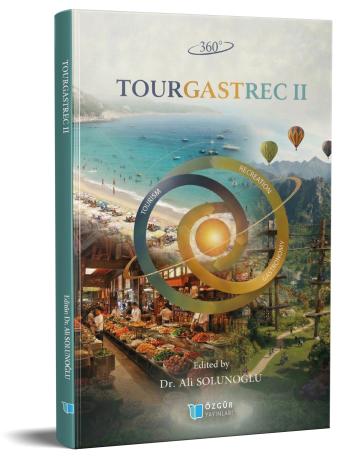
The Politics of Taste: Gastro-Nationalism in The Framework of Geographical Indications, Unesco and Gastrodiplomacy
Chapter from the book:
Solunoğlu,
A.
(ed.)
2026.
TOURGASTREC II.
Synopsis
This chapter moves beyond approaches that frame geographical indications primarily as instruments of local development and cultural heritage preservation, and instead examines how food acquires political meaning within the intersecting domains of identity, law, and diplomacy through the lens of gastro-nationalism. Food and culinary practices are conceptualized as arenas in which national identity is reproduced not only through official discourse, but also through everyday habits, popular cultural productions, and touristic experiences. In this respect, gastro-nationalism is discussed as a multi-layered field of governance operating at the intersection of cultural recognition, legal registration, and international visibility.
The study proceeds from the premise that national cuisine is not a natural or self-evident whole, but rather a construct shaped through processes of selection, organization, and standardization. Within this framework, the UNESCO Intangible Cultural Heritage mechanism and the geographical indication system are examined as key institutional instruments that confer international visibility and legitimacy upon culinary elements. Gastrodiplomacy is addressed as a complementary dimension that highlights the role of cuisine in cultural diplomacy and nation-branding processes. Through the case of Türkiye, the chapter analyzes how institutional tools—such as Law No. 6769 on Industrial Property, the registration capacity of TÜRKPATENT, the Gastrodiplomacy Committee, and Turkish Cuisine Week—operate in conjunction with one another.
The chapter concludes that an increase in the number of registrations cannot be regarded as a sufficient indicator of success. Without robust monitoring mechanisms, a value-chain-oriented approach, effective digital communication strategies, and sustained educational initiatives, policy outcomes remain limited. Furthermore, it argues that narrowly constructed narratives of national cuisine may reinforce dynamics of representation, boundary-drawing, and exclusion. In this regard, the chapter offers policy implications aimed at fostering a more inclusive, balanced, and sustainable model of culinary governance.
How to cite this book
License

This work is licensed under a Creative Commons Attribution-NonCommercial 4.0 International License.
Published
DOI
Categories
Copyright (c) 2026 Ramazan Göral; Ali Solunoğlu; Ebru Arıcı- Orhan Batman- Gizem Kandemir Altunel- Şehnaz Demirkol- Kübra Kıymet Arslan- Feyza Altun- Mustafa Emre Şirin- Suat Arpacı- Y. Kemal Özekici- Furkan Dursun- Dilek Karakaş- Canan Semint- Serkan Semint- Nuriye Demir- Betül Şahin- Hasan Cinnioğlu- Aysun Gargacı Kınay- Mehtap Baykal Erdoğan- Evrim Karaca- Ezgi Erşahin- Şehnaz Demirkol- Ayhan Başçı- Semra Akar Şahingöz- Selva Atınç- Hale Özgit- Şerif Ahmet Demirdağ- Cihan Yılmaz- Meliha Sena Yıldırgan- Pelin Candar- Özel Kılıç- Duygu Kırmızıkuşak- Mehmet Koçak- Mustafa Demirel- Halit Sökmen- Ahmet Can Göksun- Duran Kuru- Ece Rua Gülal- Sağbetullah Meriç- Yusuf Ormankıran