
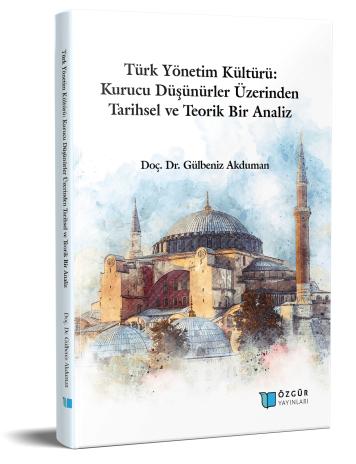
Turkish Management Culture: A Historical and Theoretical Analysis Based on Founding Thinkers
Synopsis
Management is a phenomenon as old as human history. The necessity for humans—who are social beings—to live together, engage in division of labor, share resources, and maintain order has led to the emergence of the concept of management. Each society’s understanding of management is directly related to its cultural codes. Therefore, management culture should be considered not as a universal model, but as a reflection of societies’ historical and cultural identities.
Turkish management culture has been shaped between the nomadic-steppe tradition and Islamic civilization and has, over time, reached the present through its interaction with Western modernization. In this process, figures such as Farabi, Gazali, Yusuf Has Hacib, İbn-i Haldun, Hoca Ahmed Yesevi, Yunus Emre, Mevlana, Hacı Bektaş-ı Veli, Ahi Evran and Mustafa Kemal Atatürk have made significant contributions to the development of Turkish management culture. In this context, the aim of the book is to analyze the development of Turkish management culture within the framework of the relationship between culture and management, based on the contributions of these individuals. Atatürk’s statement, “As the Turk learns about his ancestors, he will find the strength to achieve greater things,” emphasizes that a nation derives strength from its history, and this idea has also inspired this book.
Although there are many different leaders in Turkish management history, the primary reason for limiting the scope of the research to the aforementioned figures is that they represent key historical turning points reflecting the conceptual transformation of management thought. The aim of this study is not to provide a comprehensive biographical account of all leaders or thinkers in Turkish history; rather, it seeks to develop an analytical model based on exemplary figures representing the intellectual, moral, and institutional foundations of Turkish management culture.
The book adopts an approach that analyzes the theoretical and cultural codes of leadership. Although important leaders in Turkish history such as Bilge Kağan, Alparslan, Mehmed the Conqueror, Suleiman the Magnificent, and Selim I made substantial and significant contributions to management culture, they are not included in the scope of this study because the work is structured around an analysis focused on intellectual and philosophical contributions rather than institutional achievements.
In the data analysis process, the information collected through historical analysis, document analysis, and content analysis techniques was examined by identifying recurring themes in the works of thinkers (such as justice, rationality, merit, compassion, morality, solidarity, wisdom, etc.) and interpreting them within their historical context.
It is hoped that this work will serve as a reference source for researchers, academics, and practitioners who aim to understand, analyze, and develop a future-oriented model of Turkish management culture.
How to cite this book
License

This work is licensed under a Creative Commons Attribution-NonCommercial 4.0 International License.
Published
ISBN
DOI
Statistics
Categories
Copyright (c) 2026 Gülbeniz Akduman