
The Use of Artificial Intelligence in the Development of Speaking Skills
Chapter from the book:
Kılıç Avan,
Ş.
&
Kalenderoğlu,
İ.
(eds.)
2026.
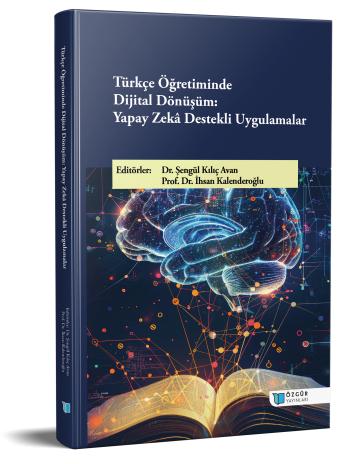
Digital Transformation in Turkish Language Teaching: AI-Powered Applications.
Synopsis
Speaking is more than the mere transfer of feelings and ideas to others during communication. This skill inherently encompasses higher-order competencies such as critical thinking, problem solving, collaboration, and social interaction. However, crowded classrooms, limited instructional time, challenges in assessment and evaluation, and differences in proficiency levels make the development of speaking skills particularly demanding. Artificial intelligence (AI), with its capacity for personalized learning, immediate feedback, and continuous accessibility, can support teachers in addressing these challenges. Through AI, students can be monitored individually, provided with tailored solutions to the difficulties they encounter, and guided or encouraged to elaborate on their spoken responses. Simulations, interactive discussion environments, and question–answer activities that foster creative thinking can be conducted through AI as if students were participating in an actual classroom setting. Moreover, speech recognition technologies embedded in AI tools enable the monitoring of pronunciation, grammar, fluency, and intonation, offering multidimensional and instant feedback. AI can also create a low-anxiety environment in which students practice speaking without fear of judgment, thereby reducing stress and promoting experiential learning. At this point, it is essential to ensure that AI does not replace the teacher but rather functions as a supportive and enriching tool in speaking instruction. Provided that planning and the evaluation of speaking performance remain under the teacher’s responsibility, AI can make significant contributions to the development of students’ fluency as well as their critical and creative speaking skills.
How to cite this book
License

This work is licensed under a Creative Commons Attribution-NonCommercial 4.0 International License.
Published
DOI
Categories
Copyright (c) 2026 Şengül Kılıç Avan- İhsan Kalenderoğlu; Şengül Kılıç Avan- İhsan Kalenderoğlu- Hüseyin Sayın- Bilal Ferhat Karadağ- Soner Garip- Rasim Tarakcı- Bekir Sıddık Kılıç- Merve Ercan- Oğuzhan Uzun- Kadir Coşkun- Arif Akçay- Çağrı Avan- Halil İbrahim Akyüz