
The Role of Artificial Intelligence and Learner Responsibility in the Development of Writing Skills
Chapter from the book:
Kılıç Avan,
Ş.
&
Kalenderoğlu,
İ.
(eds.)
2026.
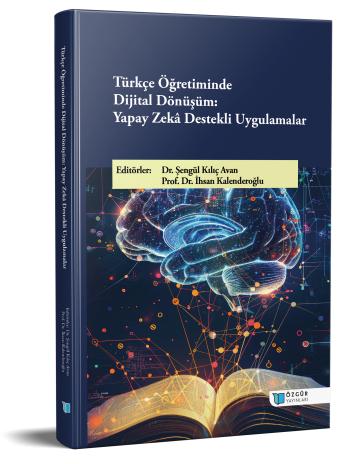
Digital Transformation in Turkish Language Teaching: AI-Powered Applications.
Synopsis
This chapter examines the role of artificial intelligence (AI)-supported applications in the development of writing skills through the lenses of the theoretical foundations of writing instruction, the process-oriented writing approach, and student responsibility. Writing is conceptualized not merely as a product of grammatical accuracy, but as a complex and recursive process involving multiple cognitive and metacognitive dimensions, including planning, drafting, reviewing, editing, and rewriting. From this perspective, the chapter argues that effective writing instruction should be grounded in process-oriented and learner-centered pedagogies rather than limited to product-based approaches. Within this framework, the pedagogical potential of AI tools in writing instruction is critically discussed. It is suggested that such tools can contribute substantially to idea generation, text development, feedback provision, linguistic revision, and assessment processes. At the same time, the chapter draws attention to the risks associated with the uncritical and unreflective use of AI in writing, particularly with regard to originality, critical thinking, academic integrity, and learner autonomy. In this regard, AI is positioned not as a substitute for student thinking and authorship, but as a supportive instrument that may enhance the writing process when used responsibly and reflectively. The chapter also presents an AI-assisted writing process model structured around the stages of planning, drafting, reviewing, and editing, and illustrates the functions of selected AI tools that may be employed in Turkish language education. In addition, the notion of student responsibility is re-evaluated in relation to AI use in educational settings, with particular emphasis on the ethical and pedagogical conditions necessary for meaningful integration. The chapter concludes that AI can serve as a valuable resource in writing education only when accompanied by pedagogical guidance, ethical awareness, and student responsibility. Finally, it offers sample activities for different stages of the writing process; these are intended as adaptable recommendations that may be revised according to classroom context and students’ readiness levels.
How to cite this book
License

This work is licensed under a Creative Commons Attribution-NonCommercial 4.0 International License.
Published
DOI
Categories
Copyright (c) 2026 Şengül Kılıç Avan- İhsan Kalenderoğlu; Şengül Kılıç Avan- İhsan Kalenderoğlu- Hüseyin Sayın- Bilal Ferhat Karadağ- Soner Garip- Rasim Tarakcı- Bekir Sıddık Kılıç- Merve Ercan- Oğuzhan Uzun- Kadir Coşkun- Arif Akçay- Çağrı Avan- Halil İbrahim Akyüz