
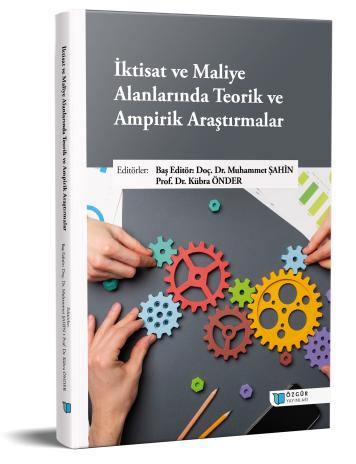
Sustainable Macroeconomic Balance, Inclusive Growth and Fiscal Policy Interaction: An Assessment of Türkiye
Chapter from the book:
Şahin,
M.
&
Önder,
K.
(eds.)
2026.
Theoretical and Empirical Research in Economics and Public Finance.
Synopsis
It is increasingly accepted that macroeconomic performance should be assessed not only through growth rates, but also through the sustainability of growth, its social inclusiveness, and its consistency with public finance. In this context, examining the relationship between economic stability and social welfare from the perspective of fiscal policy has gained particular importance. This study aims to evaluate the relationship between sustainable macroeconomic balance, inclusive growth, and fiscal policy within a holistic framework in the context of the Turkish economy.
The study is based on, first, the presentation of the conceptual framework and, subsequently, the examination of data for the 2000–2025 period through tables and graphs. This period was selected in order to address jointly the post-crisis restructuring process of the Turkish economy and the macroeconomic tensions that have become more pronounced in recent years. Within this framework, the indicators of economic growth, inflation, unemployment, and external balance, which reflect macroeconomic stability; the indicators of income distribution, poverty, female labor force participation, and youth unemployment, which relate to inclusive growth; as well as the indicators of budget balance, primary balance, tax structure, and social transfer expenditures, which represent the fiscal policy dimension, were evaluated.
The findings indicate that although economic growth in Türkiye reached relatively high levels in certain periods, this performance did not always produce a structure compatible with macroeconomic stability, income distribution, labor market outcomes, and external balance indicators. In particular, persistently high and volatile inflation, the inability to reduce unemployment permanently, continuing pressures on the current account balance, and limited improvements in inclusiveness indicators require a cautious assessment of the quality of growth. In terms of fiscal policy, the predominance of indirect taxes within the tax structure, together with the effects of social transfers and expenditure composition on inclusiveness, reveals that public finance plays a decisive role not only in maintaining fiscal discipline but also in shaping the distribution of social welfare.
In this respect, the study demonstrates that examining macroeconomic balance, inclusive growth, and fiscal policy interaction together is analytically necessary for understanding the sustainability and social quality of growth in the Turkish case. The main contribution of the study to the literature is that it brings these three dimensions together within a single analytical framework and offers a holistic contribution, from a fiscal policy perspective, to policy debates on Türkiye’s path toward sustainable and inclusive growth.
How to cite this book
License

This work is licensed under a Creative Commons Attribution-NonCommercial 4.0 International License.
Published
DOI
Categories
Copyright (c) 2026 Muhammet Şahin- Kübra Önder; Muhammet Şahin- Kübra Önder- Sevinç Yaraşır Tülümce- Pakize Karabulut- Ceyda Bayraktar Daştan- Yunus Ediz- Seçkin Kabak- Şirin Bülbül- Esin Şenol- H. Muhammet Kekeç